Case study on climate change effects and food security in Southeast Asia
July 12, 2024 | Scientific Reports | Source |
Introduction: Researchers from Skolkovo Institute of Science and Technology in Russia introduce a machine learning framework to predict crop production, focusing on Southeast Asia. It uses climate projections and agricultural data to forecast cropland suitability and changes in rice production by 2028.
Key findings: Key findings show that Indonesia, Malaysia, the Philippines, and Viet Nam may lose over 10% of cropland, with rice production declines expected in Viet Nam (19%) and Thailand (7%), while the Philippines might see a 5% increase. The model highlights the role of climate and fertilizer use, emphasizing the potential to mitigate losses through strategic land use and fertilizer application. The study underscores the importance of addressing climate change and human activities in agricultural policy-making.
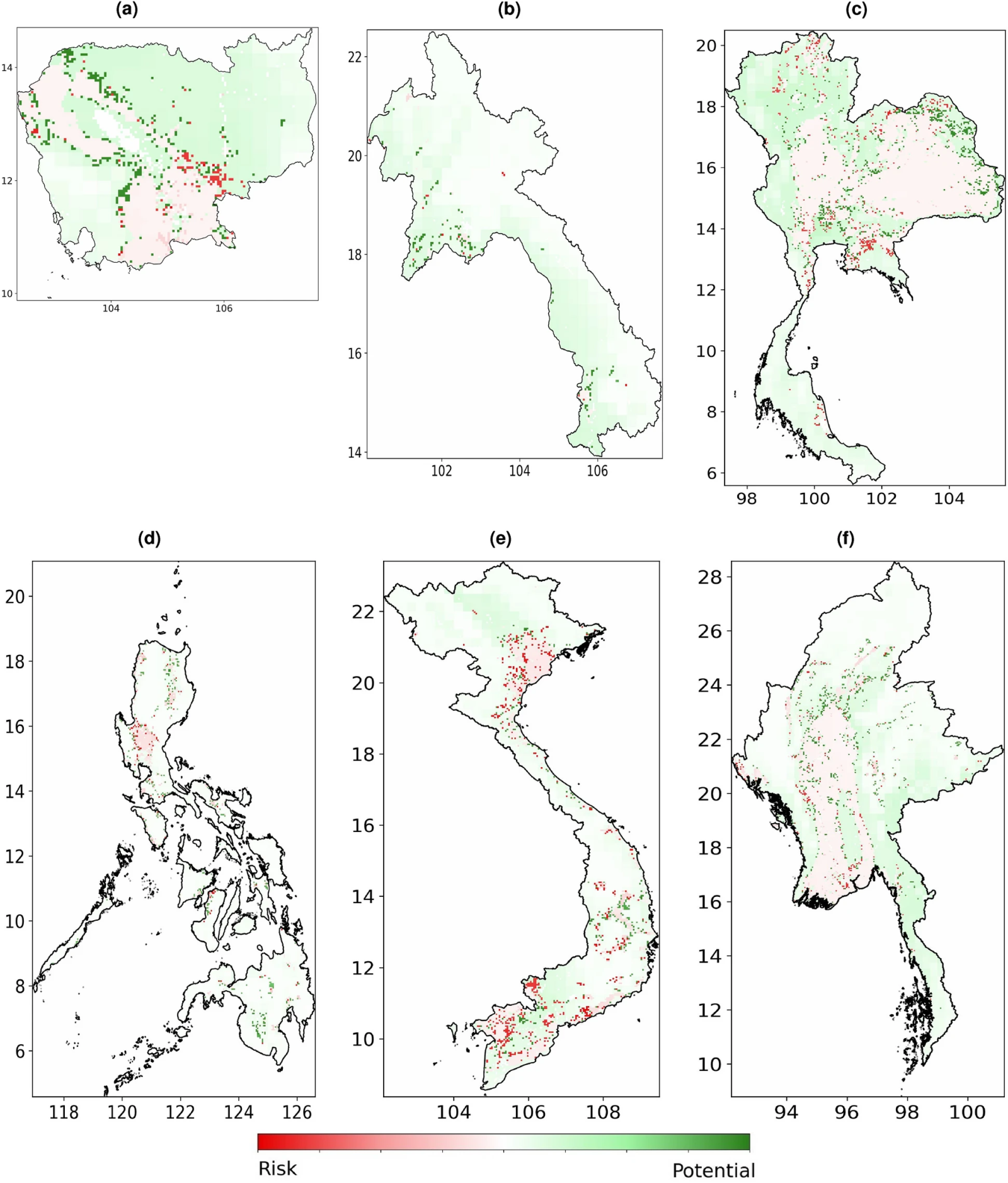
Figure | Projected changes in cropland area by 2028 relative to 2021, forecasted by the climate model for (a) Cambodia, (b) Lao PDR, (c) Thailand, (d) Philippines, (e) Viet Nam, (f) Myanmar. The horizontal axis represents longitude and the vertical axis latitude.
Viewed Articles
July 12, 2024 | Scientific Reports | Source | Introduction: Researchers from Skolkovo Institute of Science and Technology in Russia introduce a machine learning framework to predict crop production, f
May 23, 2023 | NPJ CLIMATE AND ATMOSPHERIC SCIENCE In this study conducted by the University of Chinese Academy of Sciences, Hong Kong Baptist University, and other international institutions, researc
Read More
January 15, 2022 | Atmosphere | Source | Introduction: Livestock both drives and suffers from climate change, contributing 14.5% of global GHG emissions while facing growing climate-induced stress. Re
March 9, 2023 | Science | Source | Introduction: As climate interventions, such as geoengineering and carbon sequestration, are increasingly considered to combat global warming, their potential effect
February 2023 | Trends in Ecology & Evolution |Introduction: Pollination research has historically focused on bees and globally traded crops, leaving the contribution of non-bee pollinators and locall
January 26, 2026 | Nature Communications | Introduction: While diversification is widely promoted for its multiple benefits, policymakers often question whether those benefits persist or increase ove
December 21, 2020 | Nature Food | Source | Introduction: Environmental changes, from climate shifts to extreme events, threaten food systems globally, affecting production, distribution, and consumpt


