August 30, 2019 | Global Change Biology |
Introduction: This paper is produced by an international consortium of researchers across Europe, North America, Oceania and Africa, reflecting broad expertise in soil science, modelling and land-based mitigation. The study emphasizes the global significance of soil carbon, noting that soils contain a carbon stock larger than the atmosphere and therefore represent a major potential avenue for climate mitigation. It evaluates current methods for measuring, reporting and verifying (MRV) changes in soil organic carbon (SOC) and outlines how improved MRV can support national and international climate strategies.
Key findings: SOC is difficult to monitor because changes occur slowly within a large and variable soil carbon pool. Direct sampling remains the most accurate method but becomes costly when deeper sampling is required to detect management impacts. The review notes that practices such as no-till often require sampling close to one meter and adjustments for changing soil bulk density. Flux measurements can complement sampling but are less reliable over short periods, becoming more informative only when monitored over longer time frames.
Models help scale MRV but face important uncertainties. Many models cannot fully represent key soil processes or carbon pools with long turnover times, and carbon-input estimates based on simplified relationships add further uncertainty. The review also highlights uneven MRV capacity across countries. Many developing nations rely on lower-tier reporting due to limited national soil data, reinforcing the need for international cooperation, capacity building and more harmonized approaches.
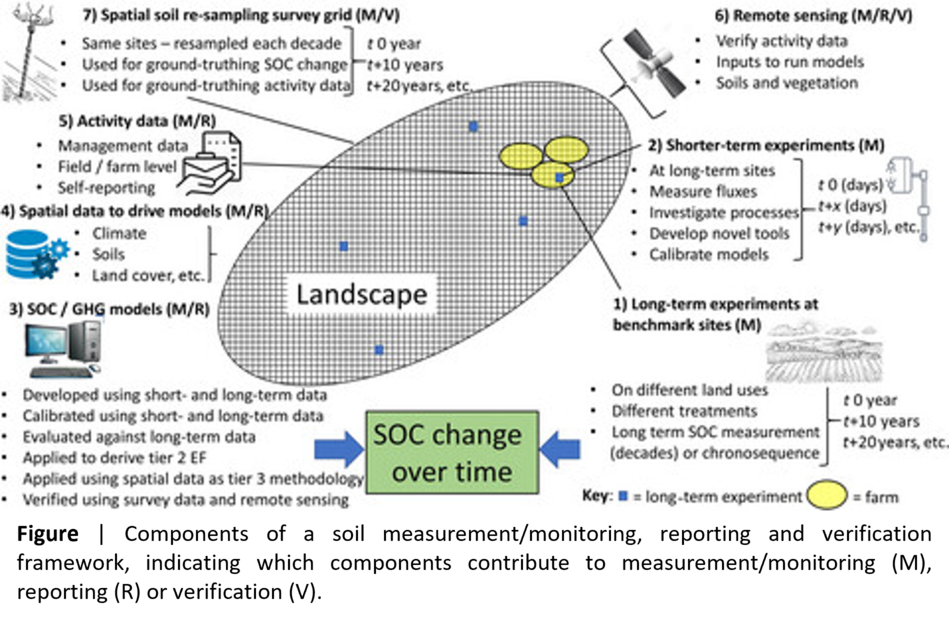
The authors present an integrated MRV vision that combines benchmark sites, calibrated models, spatial databases and repeat soil surveys supported by remote sensing to meet national reporting and market needs. This framework is intended to support major international initiatives to increase soil carbon, including the 4p1000 initiative and FAO’s global SOC sequestration assessments.