February 14, 2024 | Journal of Environmental Management |
Introduction: A research team from the University of Bologna and the University of Urbino Carlo Bo in Italy conducts a systematic mapping study on carbon-farming contracts. The study reviews 52 academic papers and draws from about 40 global case studies to build a consolidated evidence base on contract types, payment structures, and implementation challenges across regions. It responds to a central gap in the literature: information on carbon-farming contracts remains scattered, especially because many initiatives are privately led and lack transparent design details.
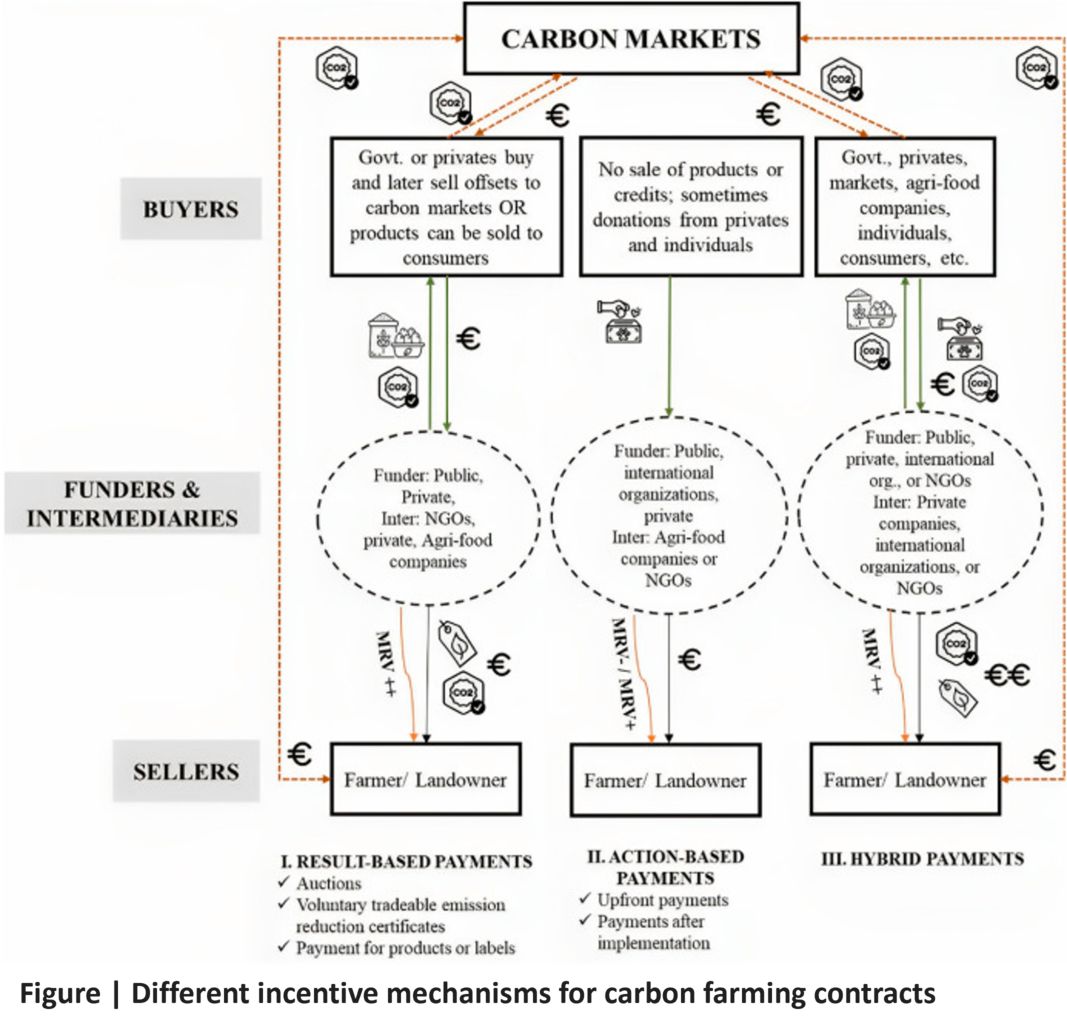
Key findings: Carbon farming has shifted from public agri-environmental programs toward market-based mechanisms that deliver both emission reductions and co-benefits such as soil health and biodiversity. Across all contract types, the most cited barriers include limited MRV capacity, challenges with permanence and additionality, and high transaction or implementation costs. Result-based contracts offer stronger climate integrity but require rigorous verification, while action-based contracts reduce risk for farmers but provide uncertain mitigation outcomes. Hybrid schemes appear more practical because they combine predictable incentives with measurable climate benefits. The study highlights the need for standardized contract rules, clearer MRV procedures, and transparent certification to improve trust and farmer participation.
It also recommends closer alignment between public funding and emerging private carbon markets to better monetize co-benefits and distribute risks, creating stronger and more stable incentives for farmers. Further improvements include third-party auditing, streamlined farmer activity reporting, and broader use of ex-ante and ex-post assessments to refine contract performance.