April, 2023 | Agricultural Systems |
Introduction: The European Green Deal places agriculture at the center of climate neutrality, biodiversity protection, and food system transformation, yet implementation trade-offs remain significant. Researchers based at the CEBAS-CSIC (Spanish Research Council) review how EU strategies—including the Farm to Fork Strategy, Common Agricultural Policy (CAP) reforms, and biodiversity and soil initiatives—frame incentives and pathways toward sustainable agriculture. The analysis draws on policy documents, scientific literature, and global datasets.
Key findings: The review frames agriculture as a hard-to-abate sector under the European Green Deal. EU agriculture accounts for around 11% of total EU GHG emissions, making it the second-largest emitting sector after energy, and sector emissions declined by about 20.5% between 1990 and 2019, largely due to reduced cattle numbers and fertilizer use. Further mitigation must address dominant sources, especially enteric fermentation and fertilizer-related N2O emissions. Beyond climate metrics, the study emphasizes systemic trade-offs shaping the transition. Sustainability targets remain in tension with maintaining yields, managing land and nitrogen demand, shifting diets, reducing food waste, and avoiding the externalization of environmental pressures beyond the EU. These interconnected challenges mean that progress in one domain may generate constraints or spillovers in others.
On policy design, the authors argue that farm-level measures alone are insufficient to deliver Green Deal objectives. Neither agroecology nor sustainable intensification can achieve all goals in isolation; instead, integrated strategies across production and consumption systems are required. Incentive design must therefore extend beyond farms to include value-chain and demand-side policies, alongside socio-economic recognition for farmers providing public goods. Within this system, CAP reforms—through conditionality, eco-schemes, and measures to address payment concentration—are positioned as necessary but not sufficient components of a broader transition architecture.
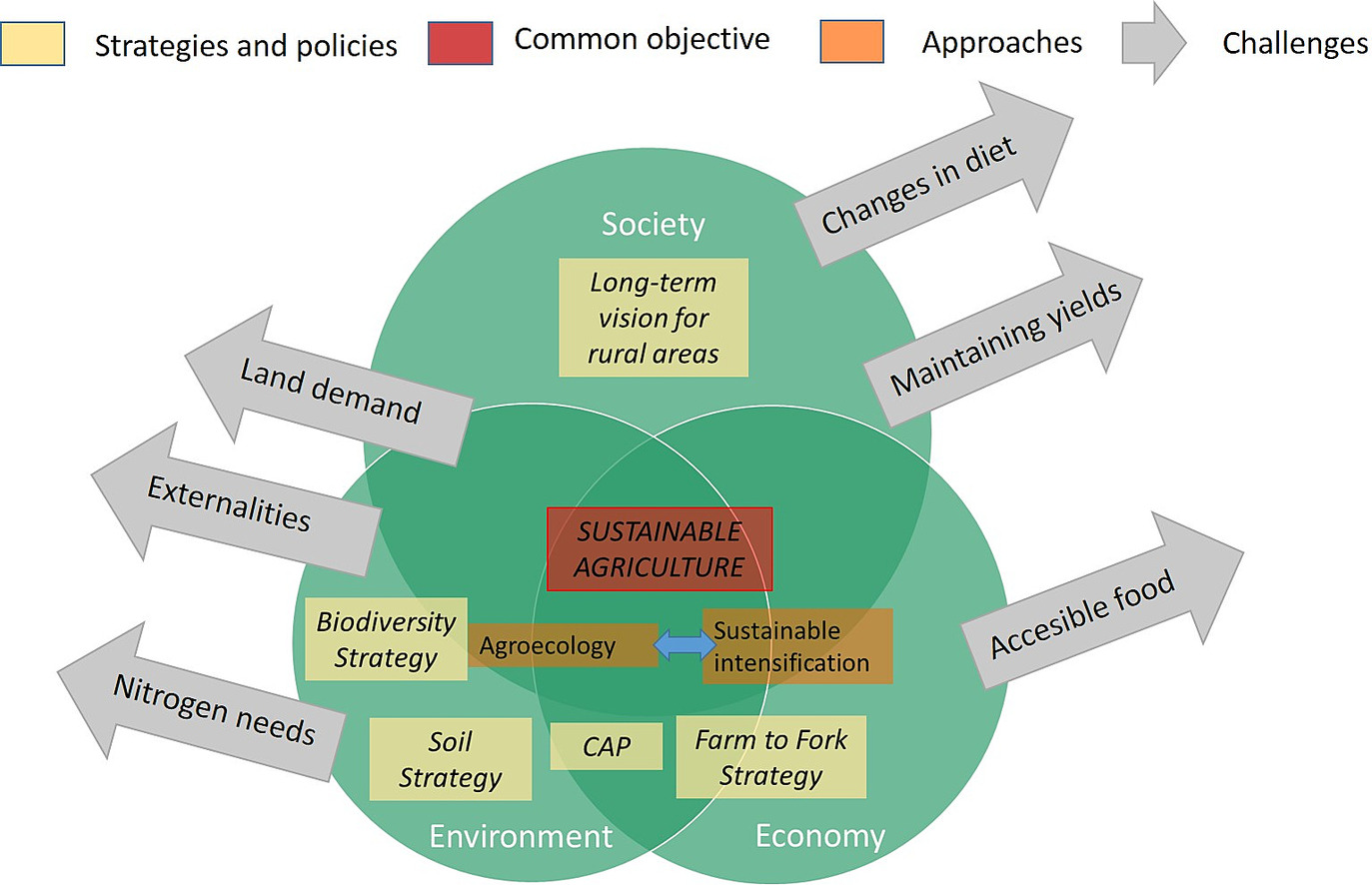
Figure | Graphical abstract


