May 6, 2022 | Journal of Rural Studies |
Introduction: Scaling climate-smart agriculture (CSA) is constrained by high investment risks, limited commercial bank engagement, and fragmented institutional support. Scholars based in Indian Institute of Management and XIM University examine why blended finance has not become a mainstream financing model for CSA, using an integrated fish farming project in Odisha, India, as a case study. The study applies an institutional and governance perspective to analyze how financial design and actor relationships shape implementation outcomes.
Key findings: The study argues that blended finance remains non-mainstream in agriculture partly because it skews toward many small deals: agriculture accounts for 22% of blended-finance transactions but only 9% of transaction volumes, signalling persistent fragmentation and weak scalability. The authors explain mainstreaming barriers through governance and moral preferences: mainstream investors often treat economic productivity as the moral compass, while impact investors prioritize social/ecological outcomes, creating hard-to-align expectations across actors.
Using the Integrated Fish Farming (IFF) case in Odisha, India, the paper shows how institutional frictions can stall scale-up: local banks hesitate due to procedural restrictions, while the implementing agency finds incentives unattractive and feels overloaded by frequent monitoring. In practice, progress depended on proximity and role complementarity—a locally embedded implementer (Gram-Utthan) identifying beneficiaries and liaising with communities, supported by NABARD and GIZ through grants, technical assistance, and capacity-building. The IFF blending described relied mainly on concessional credit, grants, and community contributions, without highlighting dedicated risk-sharing tools (e.g., guarantees/insurance) that are often discussed as blended-finance components—an important design consideration for climate-exposed farming contexts.
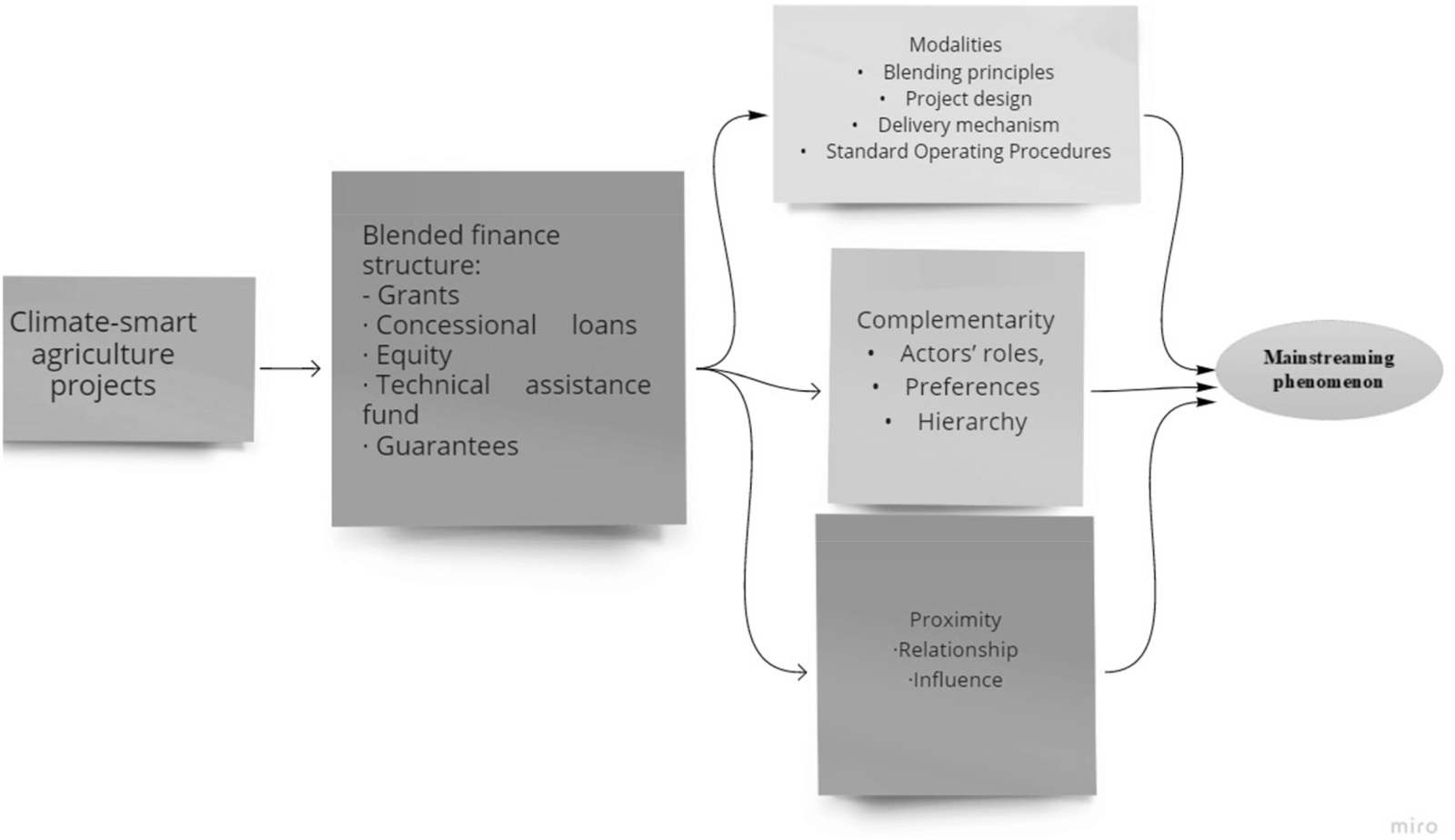
Figure | Conceptual Framework explaining the mainstreaming phenomenon.


