Search
2023-07-19
Real-time vibration monitoring and analysis of agricultural tractor drivers using an IoT-based system

MAY 25, 2023 | JOURNAL OF FIELD ROBOTICS


A recent study conducted by the University of Waterloo, Canada, along with institutes from the UAE, USA, and India, focused on the vibration exposure experienced by agricultural tractor drivers, particularly during soil tillage operations. While previous research mainly examined vertical vibration (z-axis), this study investigated the effects of rotary soil tillage on vibration acceleration, frequency, and power spectral densities (PSDs) along the three translational axes: x, y, and z. To ensure safety during the COVID-19 pandemic, the study utilized an Internet of Things (IoT) module for online data transmission, integrating with existing data loggers. Results revealed that vibration energy was more dominant along the z-axis, exceeding the exposure action value defined by Directive 2002/44/EU. PSDs indicated low-frequency vibrations induced by rotary soil tillage, while the seat-to-head transmissibility (STHT) response demonstrated higher transmissibility along the y and z axes compared to the x-axis. The frequency range of 4-7 Hz was associated with potential cognitive impairment in tractor drivers during rotary soil tillage. This study sheds light on the significant vibration exposure in agricultural settings, emphasizing the need for interventions to ensure the well-being and safety of tractor drivers.
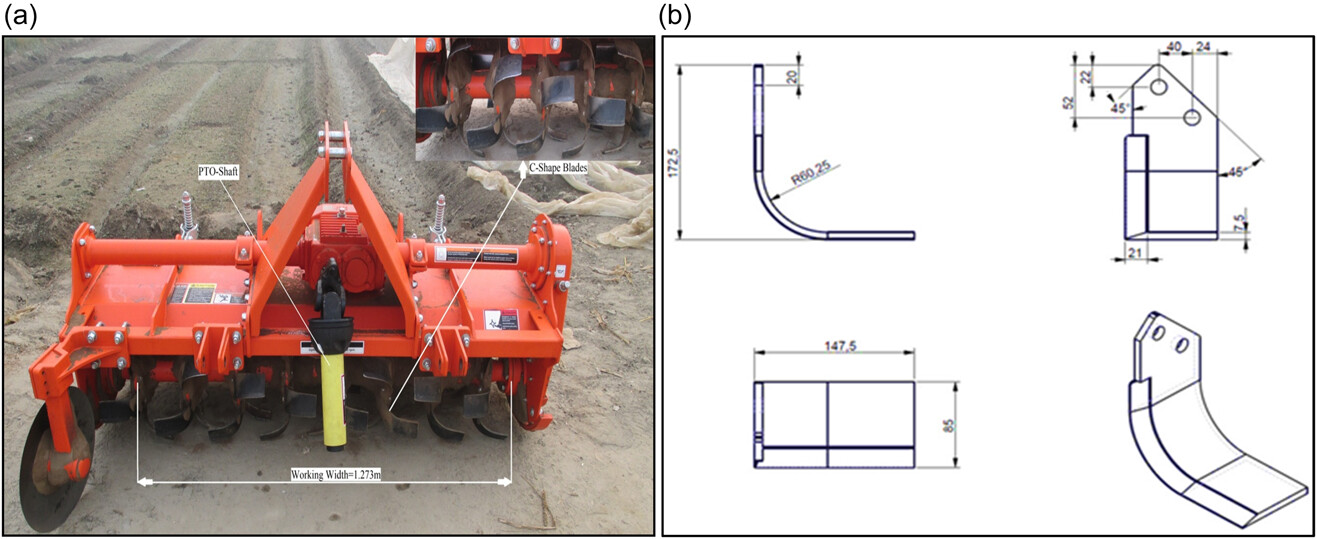
Representation of rotavator (a) and dimensions of the Cshaped blade (in mm) (b).

Viewed Articles
Real-time vibration monitoring and analysis of agricultural tractor drivers using an IoT-based system
MAY 25, 2023 | JOURNAL OF FIELD ROBOTICS A recent study conducted by the University of Waterloo, Canada, along with institutes from the UAE, USA, and India, focused on the vibration exposure experienc
Jul 19, 2023
Read More
Prediction-based breeding: Modern tools to optimize and reshape programs
October 09, 2025 | Crop Science |  Introduction: Traditional plant breeding often prioritizes explanatory models to understand biological mechanisms, which can limit the generalizability of selection
A review on enhancing water productivities adaptive to climate change
February 5, 2025 | Journal of Water and Climate Change | Introduction: Climate change is intensifying water scarcity and disrupting seasonal rainfall patterns, particularly in tropical and smallholder
Enviromic assembly increases accuracy and reduces costs of the genomic prediction for yield plasticity in maize
March, 2024 | Frontiers in Plant Science |  Introduction: Developing climate-smart agriculture requires cost-effective methods to characterize crop growing conditions. A research team from the America
Smart breeding driven by big data, artificial intelligence, and integrated genomic-enviromic prediction
November 07, 2022 | Molecular Plant |  Introduction: Climate change and population growth necessitate a transition from traditional phenotypic selection to data-driven "smart breeding". A research tea
Climate change and the urgency to transform food systems
June 23, 2022 | Science |  Introduction: Without rapid changes to agriculture and food systems, the goals of the 2015 Paris Agreement will not be met. In this review, researchers led by the University
TOP