July 14, 2025 | Land |
Introduction: Digital and precision agriculture are widely recognized for improving farm efficiency, yet less is known about their broader social and institutional effects on territorial cohesion, community revitalisation, and youth employment. Addressing this gap, researchers led by the St. Petersburg Federal Research Center of the Russian Academy of Sciences (SPC RAS, Russia) analyse how smart technologies shape rural development pathways across the European Union (EU). The study situates technology diffusion within major EU policy drivers, including the Common Agricultural Policy (CAP) Strategic Plans, SmartAgriHubs, and AgData-related initiatives.
Key findings: The study finds that digital agriculture can reduce input use, raise productivity, and ease labour constraints, while also contributing to rural revitalisation through new employment profiles in digital agronomy, IoT, and geoinformatics. Quantitative indicators suggest rapid uptake of geospatial tools: the share of farms using NDVI (Normalised Difference Vegetation Index)/SAVI (Soil-Adjusted Vegetation Index) for vegetation monitoring rose from 15% (2015) to 75% (2024), with further increases projected. The paper uses Cyprus to demonstrate how targeted EU investments can enable smaller, resource-constrained countries to advance digital transformation, including reported gains in forecast accuracy and accelerated uptake of geoinformation applications. It also reports measurable demographic and labour-market signals in digitalised areas, including a 14% decline in youth emigration in selected regions and growth in digitally oriented agricultural jobs linked to EU-supported pilots. Looking ahead, the authors argue that the next stage is a shift from partially digitalised farms toward highly autonomous production systems that integrate robotics, sensor networks, and real-time analytics, while warning that uneven infrastructure, skills, and institutional capacity can widen rural digital divides without inclusive support.
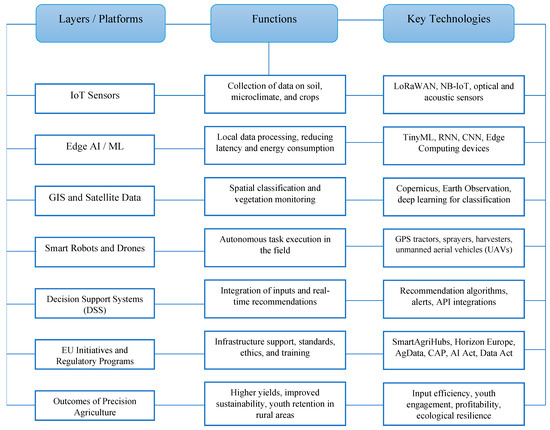
Figure | Smart agriculture platform layers.


