September, 2025 | Environmental and Sustainability Indicators |
Introduction: Carbon pricing and related climate policies are increasingly positioned as core levers for decarbonizing food systems, yet their downstream effects on food affordability, supply stability, and distributional equity remain uncertain. In this review, researchers from United Arab Emirates University (UAE), Vellore Institute of Technology (India), and the University of Swabi (Pakistan) synthesize evidence from 122 studies to examine how climate and carbon policy instruments interact with the food system as an integrated sociotechnical system, spanning agricultural production, food retail and consumption, and end-of-chain waste management.
Key findings: The review finds that poorly designed carbon policies can increase food price volatility and disproportionately affect low-income consumers and smallholder producers when applied in isolation. By contrast, integrated policy packages that combine carbon pricing with targeted subsidies, dietary guidance, and support for sustainable practices can reduce emissions while maintaining food security. From a whole food-system perspective, the authors emphasize that mitigation outcomes depend on policy coherence across production, consumption, and waste management, rather than farm-level interventions alone. The review further highlights that managing distributional impacts, cultural food practices, and urban–rural linkages require reflexive governance approaches that allow policy objectives and pathways to be periodically reassessed as conditions and trade-offs evolve. Persistent research gaps remain, particularly in localized dietary emissions data, real-time decision-support tools, and equity-focused policy evaluation. The study provides actionable policy pathways by shifting the debate from whether carbon pricing should be applied to how climate and food policies can be jointly designed and governed.
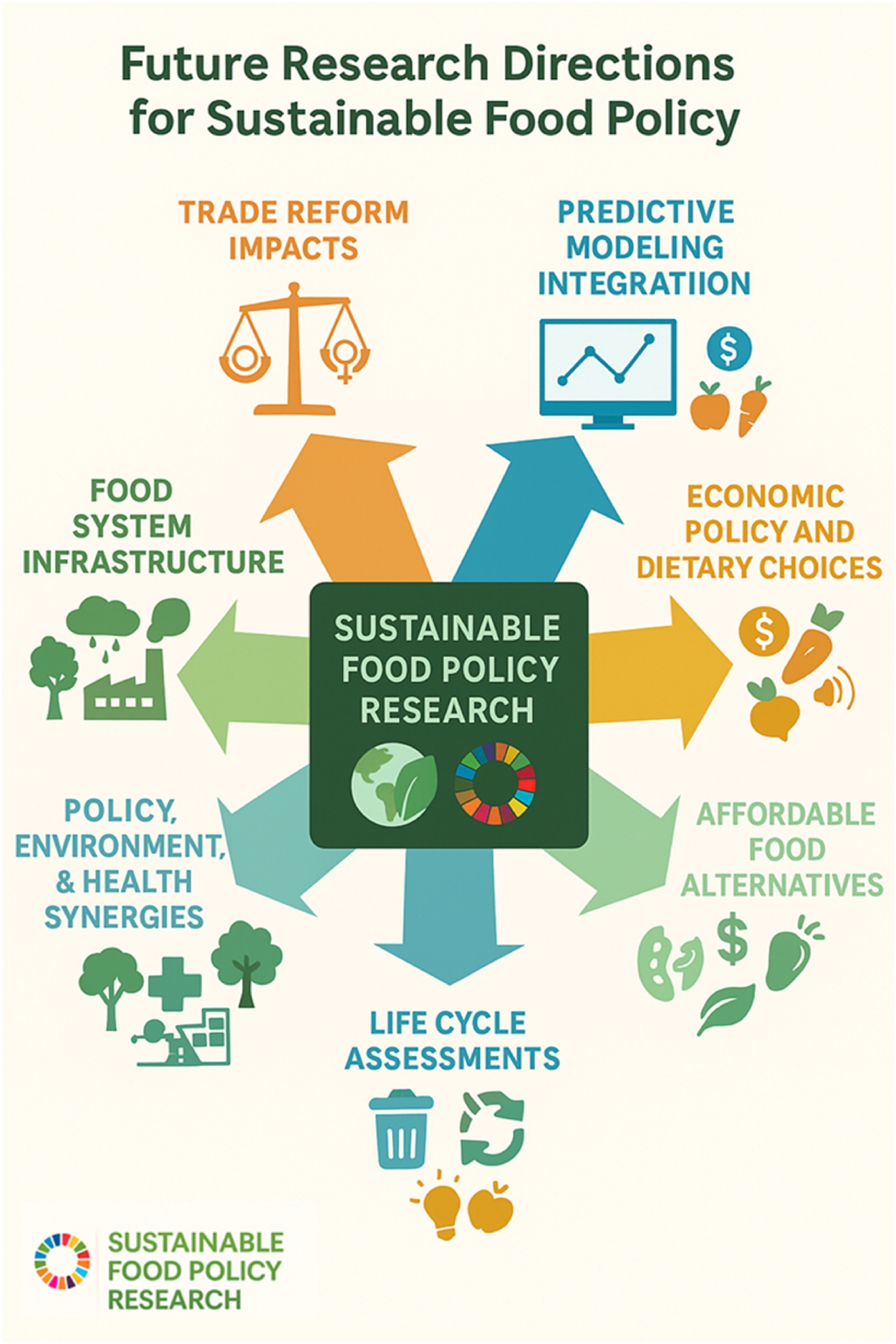
Figure | Future research directions for sustainable food policy.


