May 22, 2020 | Frontiers in Sustainable Food Systems |
Introduction: Global pathways consistent with the Paris Agreement rely on substantial reductions in agricultural methane (CH4) and N2O alongside net-zero fossil CO₂. The authors argue that failure to reduce agricultural emissions would make limiting warming to 1.5°C by mid-century all but impossible and would further constrain the remaining carbon budget, increasing reliance on large-scale carbon dioxide removal with associated food-security risks. Led by the New Zealand Agricultural Greenhouse Gas Research Centre (New Zealand), this study reviews why modeled mitigation pathways, often achieved through high carbon prices on agricultural emissions, diverge sharply from real-world policy feasibility.
Key findings: The review highlights a persistent gap between modelled mitigation pathways and policy reality. Most scenarios achieving the required agricultural reductions depend on mandatory emission pricing that reaches high levels over time, yet no country has implemented a compulsory carbon price for agricultural emissions, reflecting concerns about competitiveness, leakage, and impacts on food security and livelihoods. Beyond government policy, the authors identify entry points where non-governmental actors may influence mitigation, including large international food companies setting supply-chain emissions targets and requiring suppliers to meet climate goals, as well as consumer-facing mechanisms such as carbon footprint labelling and shifts in dietary demand. However, the scalability and effectiveness of these pathways remain uncertain, particularly for smallholder and subsistence systems. The review also evaluates productivity and emissions-intensity improvements as a pragmatic starting point because they can align with food security objectives, but it cautions that climate benefits are conditional. Without coordinated changes in food demand, dietary choices, and land-use policies, productivity gains can increase total production and ultimately raise absolute emissions or induce indirect land-use change. Overall, the authors call for integrated supply- and demand-side strategies that bridge the gap between technically plausible mitigation and politically feasible implementation.
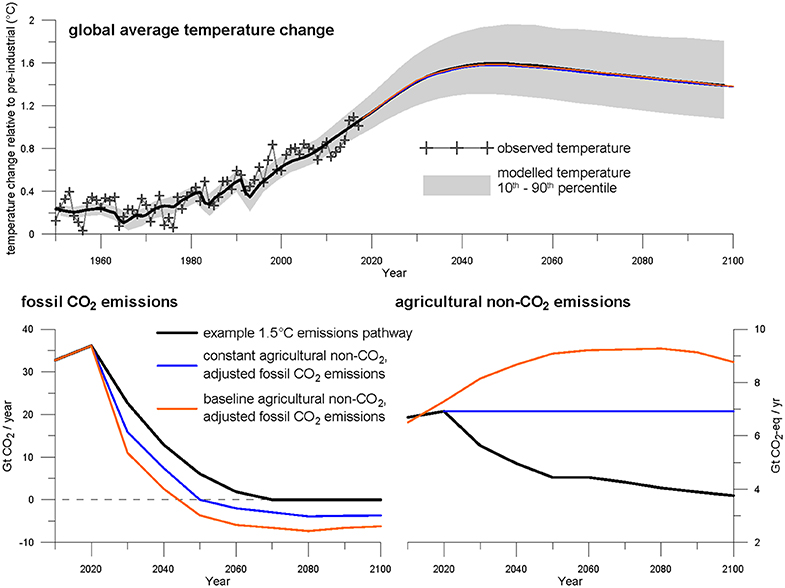
Figure | Three alternative global pathways of fossil CO2 and agricultural non-CO2 (CH4 and N2O) emissions consistent with global warming of 1.5°C. The lower panels show fossil CO2 (left panel) and agricultural non-CO2 (right panel) emissions.


