June 23, 2022 | Science |
Introduction: Without rapid changes to agriculture and food systems, the goals of the 2015 Paris Agreement will not be met. In this review, researchers led by the University of Oxford (UK), Erasmus University Rotterdam (Netherlands), and Stellenbosch University (South Africa) argue that transformation is urgent not only because food systems generate about one-third of anthropogenic GHG emissions, but also because they fail to deliver equitable food and nutrition security and drive broader environmental harms. The review highlights the central challenge of designing governance arrangements capable of navigating trade-offs between mitigation options and food security implications across the entire food supply chain.
Key findings: The review concludes that current food system trajectories are incompatible with achieving the goals of the Paris Agreement. Even substantial improvements in production efficiency are insufficient, as mitigation measures confined to the farm level cannot deliver the required emissions reductions without concurrent changes in consumption patterns, land use, and post–farm gate activities. The authors identify persistent systemic barriers that have limited progress to date, including fragmented governance across climate and food policy domains, entrenched interests, and power asymmetries that constrain transformative action. A central challenge for implementation lies in managing trade-offs among mitigation options and other food system outcomes. While many interventions generate potential synergies, they can also create conflicts with food and nutrition security, farmer livelihoods, or local environmental conditions depending on context. The review emphasizes that these trade-offs are often insufficiently recognized at the design stage, leading to resistance and policy failure during implementation. To address this, the authors call for new governance arrangements capable of coordinating actors across the entire food supply chain, making trade-offs explicit from the outset, and guiding integrated packages of mitigation and adaptation measures rather than isolated or sector-specific interventions.
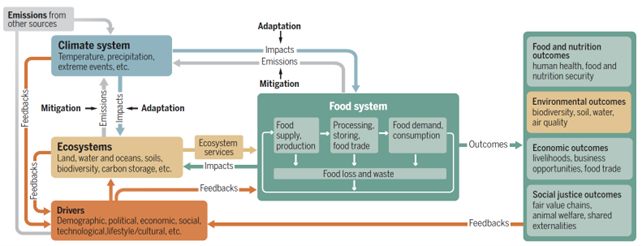
Figure | How climate change, ecosystems, and food system drivers interact to affect food security.


