February, 2025 | Agricultural Systems |
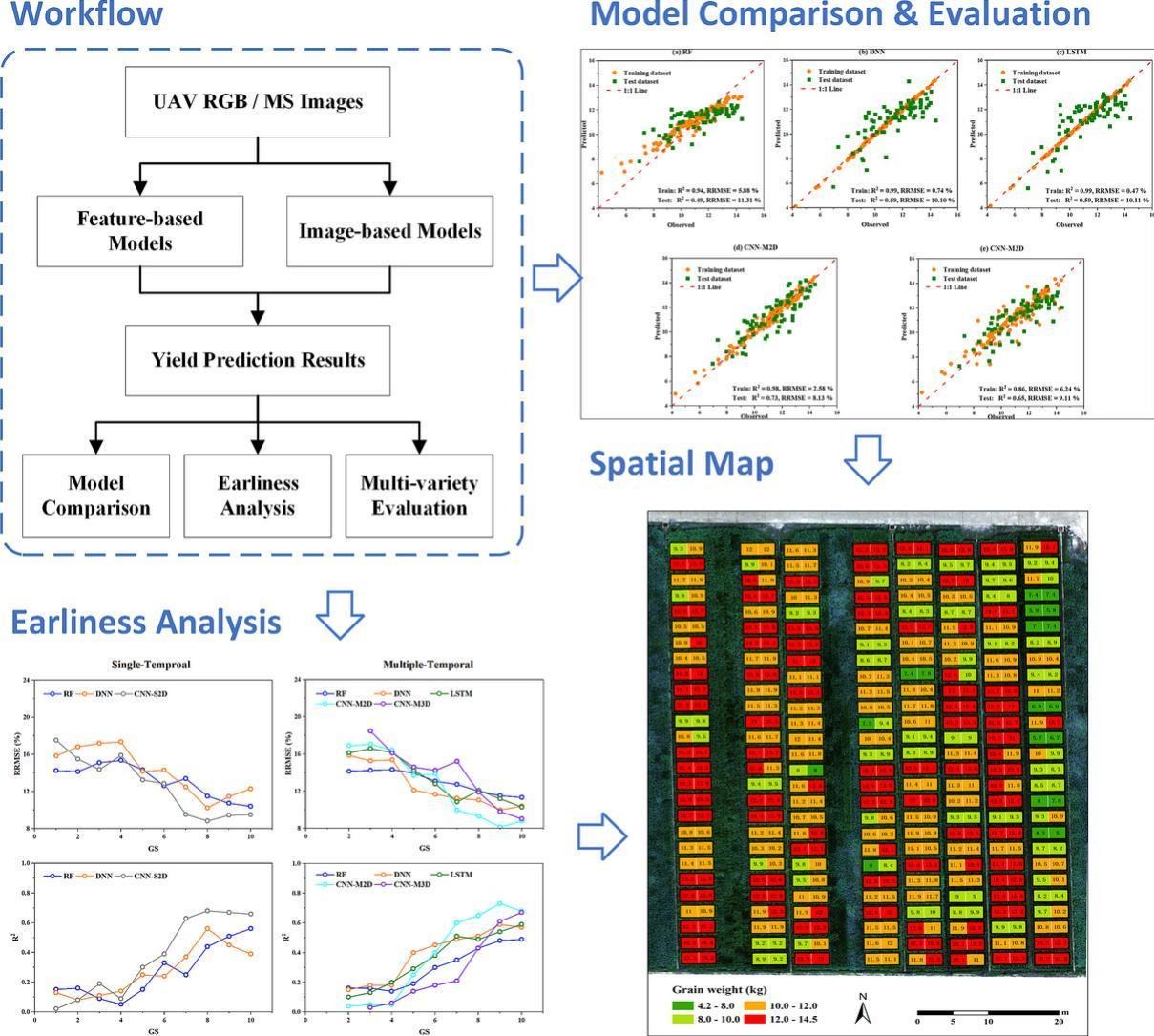
Introduction: Accurate and timely yield prediction is critical for breeding trials, as it enables early elimination of poor-performing varieties and accelerates selection decisions. Researchers from the Zhejiang Academy of Agricultural Sciences (China) report an empirical study conducted in eastern China that addresses a practical limitation in current breeding-oriented yield prediction: the lack of models that perform reliably across a large number of genetically diverse varieties. Using UAV-based multispectral imaging, the authors compare traditional feature-based machine learning approaches with image-based deep learning models across 216 hybrid rice varieties. The study aims to identify the optimal model architecture and prediction timing that can deliver high-precision yield estimates early enough to support large-scale breeding programs.
Key findings: Image-based deep learning models consistently outperformed handcrafted feature-based models, largely due to their ability to capture spatial information such as texture and canopy structure from multispectral images. Among the tested architectures, a multi-temporal two-dimensional convolutional neural network (CNN-M2D) achieved the best performance, with a relative root mean square error (RRMSE) of 8.13% and an R² of 0.73, demonstrating robust accuracy across genetically diverse rice varieties. Model performance improved as crops progressed through growth stages, with the optimal prediction window occurring from flowering to grain filling, corresponding to an ideal lead time of approximately one month before harvest. Stratified sampling further enhanced generalization by ensuring balanced representation of varietal categories during training, thereby reducing the mismatch between source and target domains when predicting yield across a large and diverse set of varieties. While image-based models required higher computational resources, they delivered more stable and consistent yield predictions across varieties. Overall, the study shows that UAV-based deep learning offers a practical high-throughput phenotyping approach to support earlier and more reliable selection in rice breeding trials, with potential applicability to other major crops.
Graphical abstract