January 26, 2026 | Nature Communications |
Introduction: While diversification is widely promoted for its multiple benefits, policymakers often question whether those benefits persist or increase over time. This second-order meta-analysis, led by researchers from Westlake University (China) and Swiss research institutes, synthesizes findings from 184 meta-analyses spanning up to 120 years to assess how diversification influences profitability, biodiversity, soil quality, and climate-related ecosystem services over time.
Key findings: The analysis concludes that diversification tends to generate bundled benefits that include economic, ecological, and ecosystem service gains rather than isolated improvements. This pattern is important for long-term persistence and real-world carbon outcomes because SOC benefits depend on sustained practice adoption. The study also highlights that diversification strengthens regulating services such as soil structure, nutrient cycling, and biological control, which are closely linked to SOC stabilization processes and reduced degradation risks. From a policy perspective, soil carbon strategies are likely to be more durable when embedded within diversification packages that farmers perceive as lowering risk and improving returns. However, program design must still account for contextual factors including baseline farming systems, climate constraints, and transition costs to avoid overstating expected outcomes.
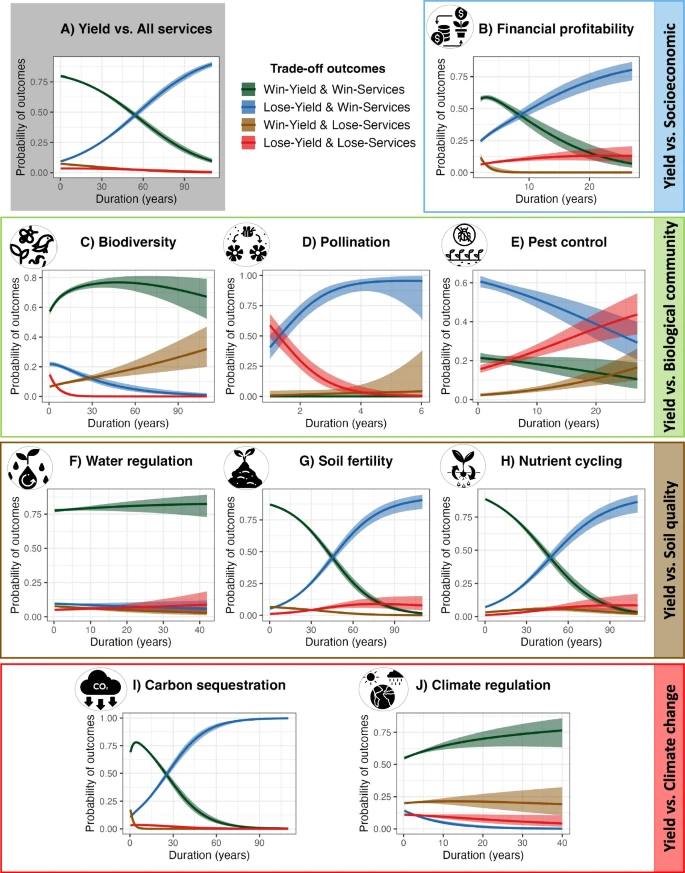
Figure | Effects of agricultural diversification on socioeconomic, biological community, soil quality, and climate change-related variables over time compared to non-temporal effects.


