August 26, 2023 | Environmental Monitoring and Assessment |
Introduction: Lowland rice systems present a well-known climate trade-off, as management practices that increase soil organic carbon (SOC) inputs can also stimulate methane emissions under flooded conditions. This study evaluates SOC sequestration potential alongside methane emissions under different management options in lowland rice, led by Indian researchers from the ICAR–National Rice Research Institute, with a focus on management-relevant evidence rather than purely theoretical potential.
Key findings: The study shows that management can deliver climate benefits only when SOC and CH₄ are assessed together. Biochar stands out as a dual-benefit option in the reviewed evidence, with reported CH₄ reductions of approximately 45.2% to 54.9% alongside SOC gains, depending on feedstock type, application rate, and site conditions. In contrast, mid-season drainage can reduce CH₄ emissions but may also decrease carbon accumulation, with one cited finding indicating a reduction of about 60%, highlighting a potential SOC penalty if drainage is poorly timed or too frequent. The authors therefore recommend integrated management packages that combine improved water management, organic amendments with lower methanogenic potential, and optimized nutrient strategies, together with MRV approaches that track both SOC changes and CH₄ fluxes to avoid burden shifting. Limitations include heterogeneity across experiments and the need for longer-term field trials that assess SOC persistence and methane dynamics across multiple growing seasons.
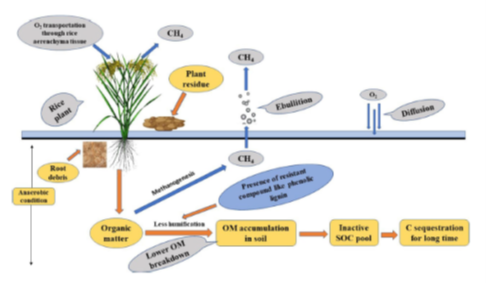
Figure | Schematic diagram of CH4 emission and C sequestration in rice soil.


