August 06, 2021 | Communications Earth & Environment |
Introduction: Rice paddies are widely discussed for methane emissions, but their role as carbon stores is less consistently quantified. Led by Chinese researchers from Shenyang Agricultural University and comprising a cross-disciplinary team from across Europe, this study compiles a global dataset to quantify carbon stocks in paddy soils and evaluate their significance within the global soil carbon pool.
Key findings: Using a global synthesis, the authors estimate that rice paddy soils store roughly 45 Mg C ha⁻¹ on average (to ~1 m depth) and that this stock is comparable in magnitude to carbon stored in other major soil categories. They further project that the area under rice cultivation could expand by >30% by 2050, implying that paddy soils will remain a substantial global carbon pool even as mitigation efforts target rice CH₄ emissions. The paper’s policy relevance is that mitigation strategies in rice systems should be evaluated on net climate outcomes: practices that reduce CH₄ but erode soil carbon could undermine long-term benefits, while approaches that protect/raise SOC can complement CH₄ reductions. A key limitation is spatial data unevenness (some regions and soil depths are underrepresented), which affects uncertainty in global upscaling; the authors’ synthesis underscores the need for more standardized, depth-resolved SOC measurements in rice landscapes to improve national inventories and MRV.
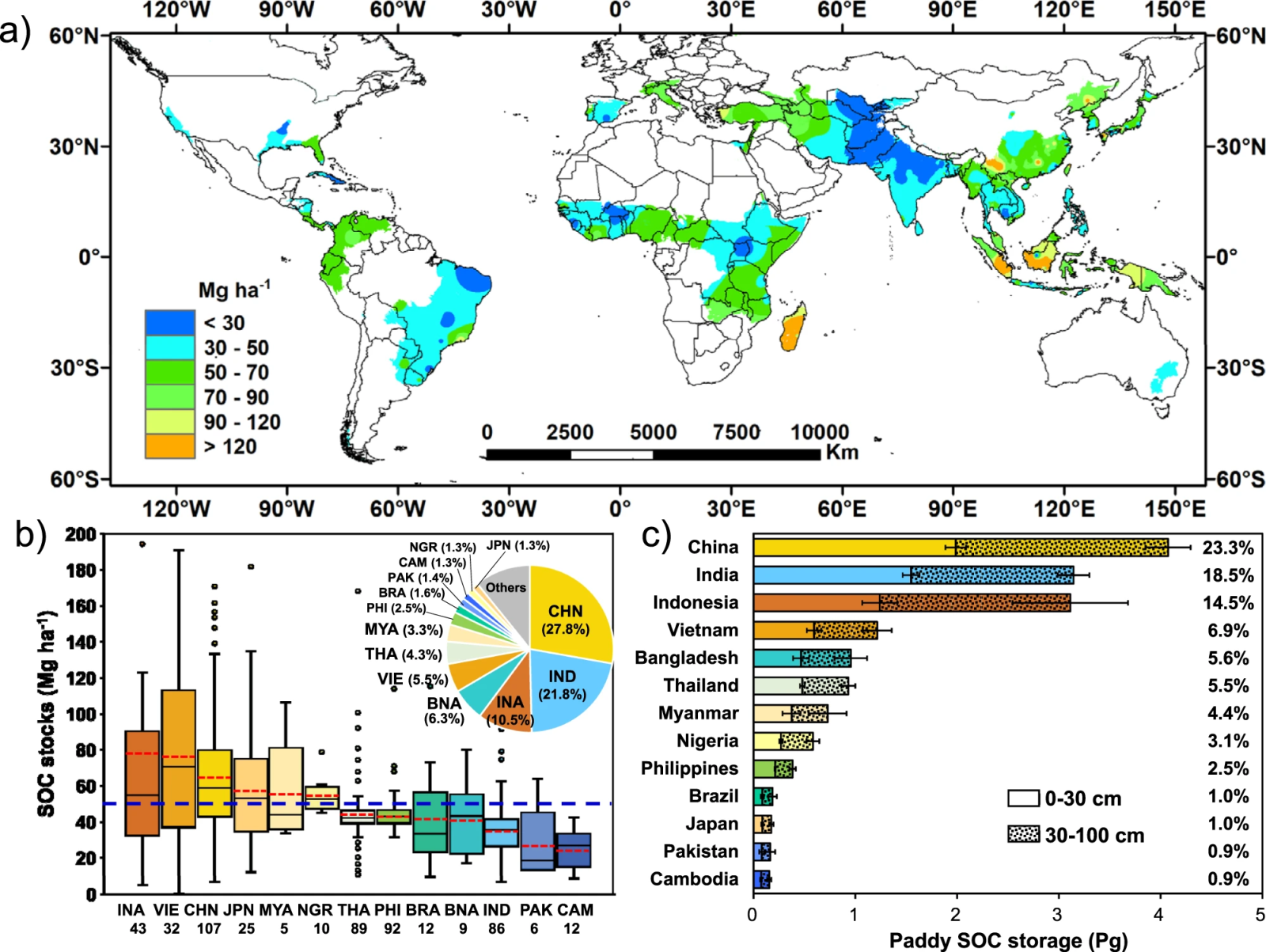
Figure | Map view and soil organic C stocks of the main rice-producing countries.


