Search
Impact of agricultural management practices on soil carbon sequestration and its monitoring through simulation models and remote sensing techniques: A review
Sources of information

August 27, 2020 | Critical Reviews in Environmental Science and Technology |


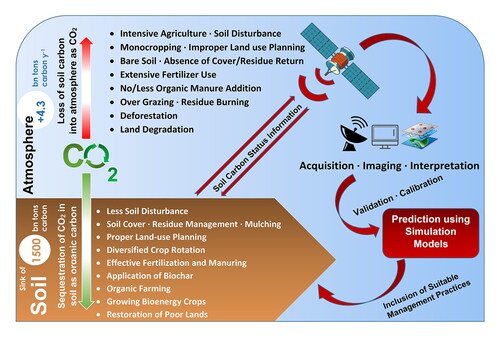
Introduction: Led by an India-based team from Bidhan Chandra Krishi Viswavidyalaya, the Indian Institute of Remote Sensing (IIRS)-ISRO, and Punjab Agricultural University, the authors synthesize evidence on how common agronomic practices influence soil organic carbon (SOC) stocks and evaluate how process-based models (e.g., RothC, Century, DNDC) together with satellite and airborne remote sensing can support scalable SOC assessment.


Key findings: Across the literature reviewed, conservation-oriented practices such as reduced or no tillage, residue retention, diversified rotations or cover crops, balanced fertilization, and organic amendments are consistently associated with higher SOC accumulation, although effect sizes vary with climate, soil texture, baseline SOC, and duration of adoption. SOC gains are often concentrated in the topsoil, which may overestimate whole-profile sequestration if deeper layers are not measured or modelled. For monitoring, the authors emphasize that process-based models can estimate SOC trajectories and distinguish management effects from climate variability, but they require well-calibrated inputs and long-term field validation. Remote sensing is most useful for mapping indicators related to SOC dynamics, including vegetation productivity, residue cover, and soil moisture, and for scaling model outputs rather than directly measuring SOC from space. The review concludes that robust MRV requires integrated workflows combining field sampling, modelling, and remote sensing, together with transparent uncertainty reporting to support carbon credit or results-based policy programs.


Graphical abstract
Viewed Articles
Impact of agricultural management practices on soil carbon sequestration and its monitoring through simulation models and remote sensing techniques: A review
August 27, 2020 | Critical Reviews in Environmental Science and Technology |  Introduction: Led by an India-based team from Bidhan Chandra Krishi Viswavidyalaya, the Indian Institute of Remote Sensing
Read More
Long-term agricultural diversification increases financial profitability, biodiversity, and ecosystem services: a second-order meta-analysis
January 26, 2026 | Nature Communications |  Introduction: While diversification is widely promoted for its multiple benefits, policymakers often question whether those benefits persist or increase ove
Climate-smart agroforestry systems and practices: A systematic review of what works, what doesn’t work, and why
May, 2023 | Forest Policy and Economics | Source | Introduction: Climate-smart agroforestry (CSAF) practices offer integrated solutions to climate change, food security, and environmental degradation,
Priority areas to protect mangroves and maximise ecosystem services
September 21, 2023 | Nature Communications | Source | Introduction: Human activities are threatening global biodiversity and the ecosystem services provided by mangroves. Current conservation efforts
Carbon sequestration potential of agroforestry systems in Indian agricultural landscape: A Meta-Analysis
August, 2023 | Ecosystem Services | Source |  Introduction: Agricultural intensification in India threatens ecosystem sustainability, with agroforestry identified as a key strategy to mitigate these i
Soil carbon sequestration increment and carbon-negative emissions in alternate wetting and drying paddy ecosystems through biochar incorporation
July 1, 2024 | Agricultural Water Management | Source |  Introduction: Alternate wetting and drying (AWD) is a widely adopted water-saving irrigation technique in Asian rice-producing countries that i
TOP