November 20, 2020 | Journal of Cleaner Production |
Introduction: Greenhouses account for the largest share of final energy consumption in agriculture, with heating alone consuming 65-85% of total energy. Despite the importance of control strategies for reducing energy use while maintaining suitable growing conditions, no systematic review had examined these methodologies comprehensively. Researchers from China Agricultural University, the University of Liverpool (UK), and the Fraunhofer Institute for Building Physics (Germany) conducted a systematic review of control strategy methodologies for improving energy efficiency in agricultural greenhouses, covering mathematical modelling, physical experiments, numerical simulations, and parametric sensitivity analysis across more than 30 performance-affecting parameters.
Key findings: The review identified that approximately 60% of the literature focuses on temperature and humidity as the primary controlled parameters, which directly affect both crop yield and energy consumption. Numerical simulation using MATLAB/Simulink is the most common methodology (around 30% of studies), while real physical experiments validating model accuracy remain very few. Since the 2010s, a clear trend has emerged: combining traditional control strategies such as PID and fuzzy logic with artificial neural networks and intelligent algorithms to simultaneously reduce energy consumption and maintain optimal microclimates. Specific energy savings reported include 36% water savings and 30% less electricity through improved cooling control, and 9% energy cost reduction via hybrid control during cold days. Over 30 control strategies were evaluated, with model predictive control, fuzzy control, and hybrid approaches consistently recommended for low-energy greenhouses. The authors identified that integrating big data, artificial intelligence, and machine learning with advanced control strategies will drive a revolution in greenhouse energy management, and that incorporating renewable energy and passive house technologies could bring agricultural greenhouses toward net-zero energy status.
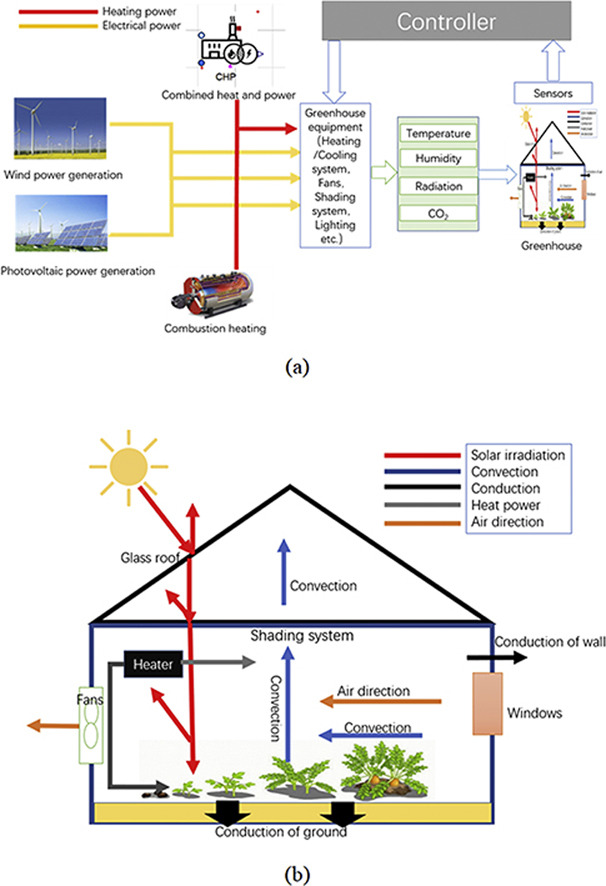
Graphical abstract | Relationship among controller, greenhouse equipment supplied by thermal and electrical energy, controlled environmental factors (temperature, humidity etc.) and sensors in the greenhouse (a), detailed thermal environment inside the greenhouse (b).