February, 2022 | Renewable and Sustainable Energy Reviews |
Introduction: Poultry housing may account for up to 50% of total non-renewable energy use and 20-35% of the life cycle impacts of poultry production, yet net zero energy (NZE) building design remains an under-explored mitigation strategy for the livestock sector. Researchers from the University of British Columbia Okanagan (Canada) conducted a PRISMA systematic review of 249 papers to identify insights from commercial and residential NZE building research applicable to poultry housing, quantify the magnitude and distribution of energy use in poultry facilities, and determine priority design considerations accounting for the physiological requirements of confined poultry production.
Key findings: The review found that heating, ventilation, and air conditioning (HVAC) systems dominate direct energy use in poultry housing, with heating as the primary consumer during cold seasons and ventilation during warm seasons. Three categories of strategies were identified as essential for achieving NZE status: 1) reducing energy use through passive design (especially improved insulation over maximizing glazed area, given poultry photoperiod requirements), 2) improving energy efficiency of active systems (LED lighting reducing energy by 80-85%, heat recovery ventilators, ground-source heat pumps), and 3) implementing context-appropriate renewable energy generation (solar PV, wind turbines, biomass from poultry litter, anaerobic digestion). The authors emphasized that poultry-specific constraints - including thermo-neutral temperature ranges, high ventilation rates for air quality, and humidity control - require design adaptations not found in commercial building NZEB research. Key gaps identified include the need for hybrid technology integration rather than isolated solutions, simulation models tailored to poultry housing, and smart control systems with sensor networks for real-time monitoring adapted to the dynamic physiological needs of birds across growth stages.
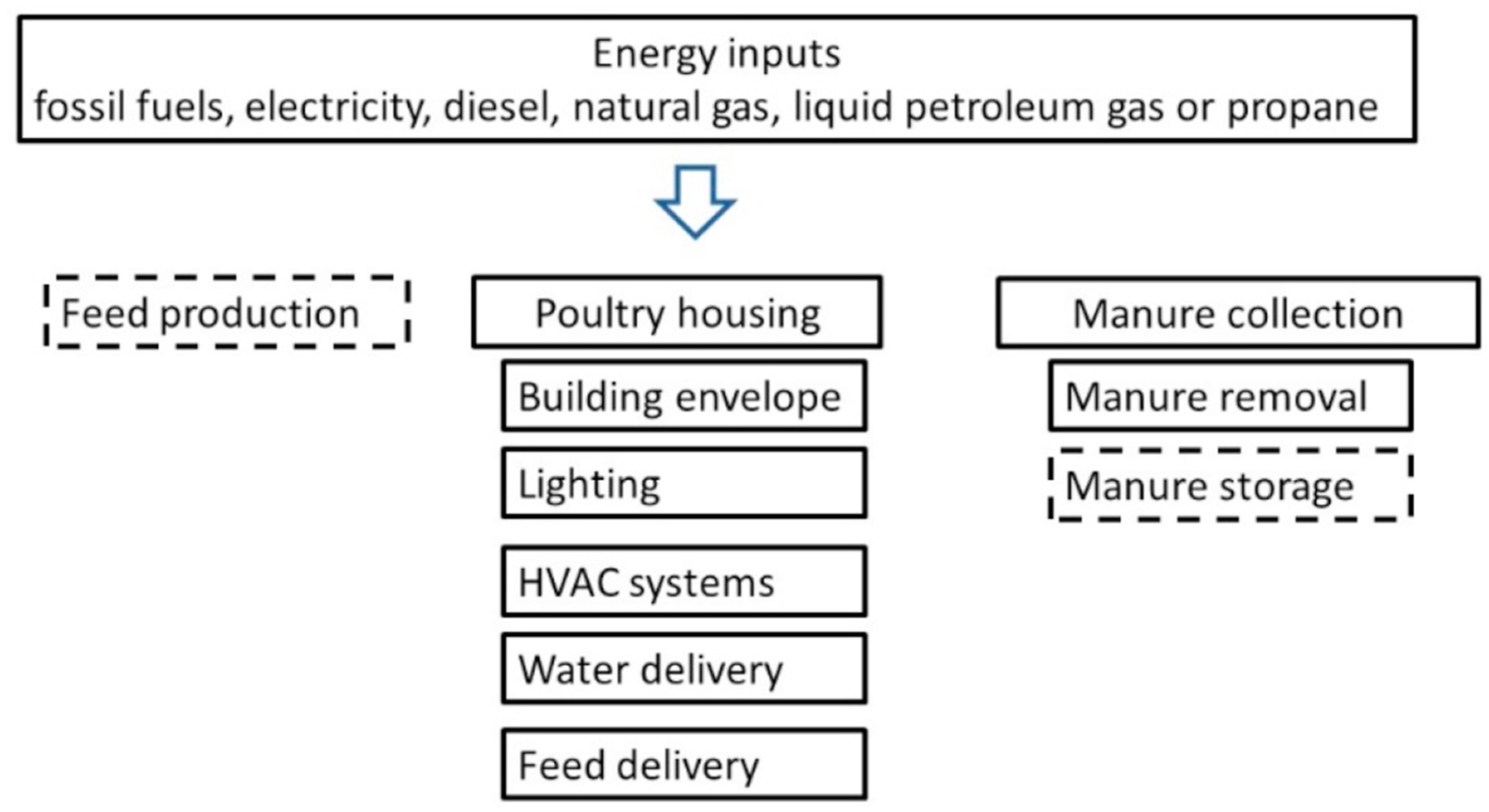
Figure | Analyzed boundary of poultry housing (activities in the dotted boxes were excluded).


