January 17, 2025 | Scientific Reports |
Introduction: Greenhouses require stable energy supplies for maintaining optimal environmental conditions, yet their heavy reliance on grid electricity increases operational costs and carbon footprints. Semi-transparent photovoltaic (STPV) systems can generate electricity while allowing sufficient light for plant growth, but their intermittent output creates reliability challenges. Researchers from Final International University (Turkey), Murdoch University (Australia), and Qatar University investigated whether integrating Battery Energy Storage Systems (BESS) with STPV panels could enhance greenhouse energy autonomy, using the Harmony Search optimization algorithm to determine optimal BESS sizing and placement across seasonal scenarios.
Key findings: Incorporating BESS significantly reduced grid dependency, with the energy autonomy factor improving from 43.43% to 24.17% in summer and from 81.36% to 69.45% in winter. Performance was highly sensitive to STPV panel transmittance rates and the minimum Daily Light Integral (DLI) required by crops - higher DLI requirements constrained the allowable STPV area, reducing energy generation capacity. Financial analysis showed BESS integration reduced total operational costs by 13.5% in summer and 6.1% in winter, with 20-year Net Present Value (NPV) improving from $712,392 to $946,730 in summer. Temperature effects on panel efficiency further influenced energy autonomy by 1.7-6.7% depending on season and DLI. The authors noted that achieving year-round energy autonomy requires dynamic seasonal adjustments to BESS and STPV configurations, and suggested that complementary solutions such as hydrogen storage could further reduce grid dependency during low-irradiance periods.
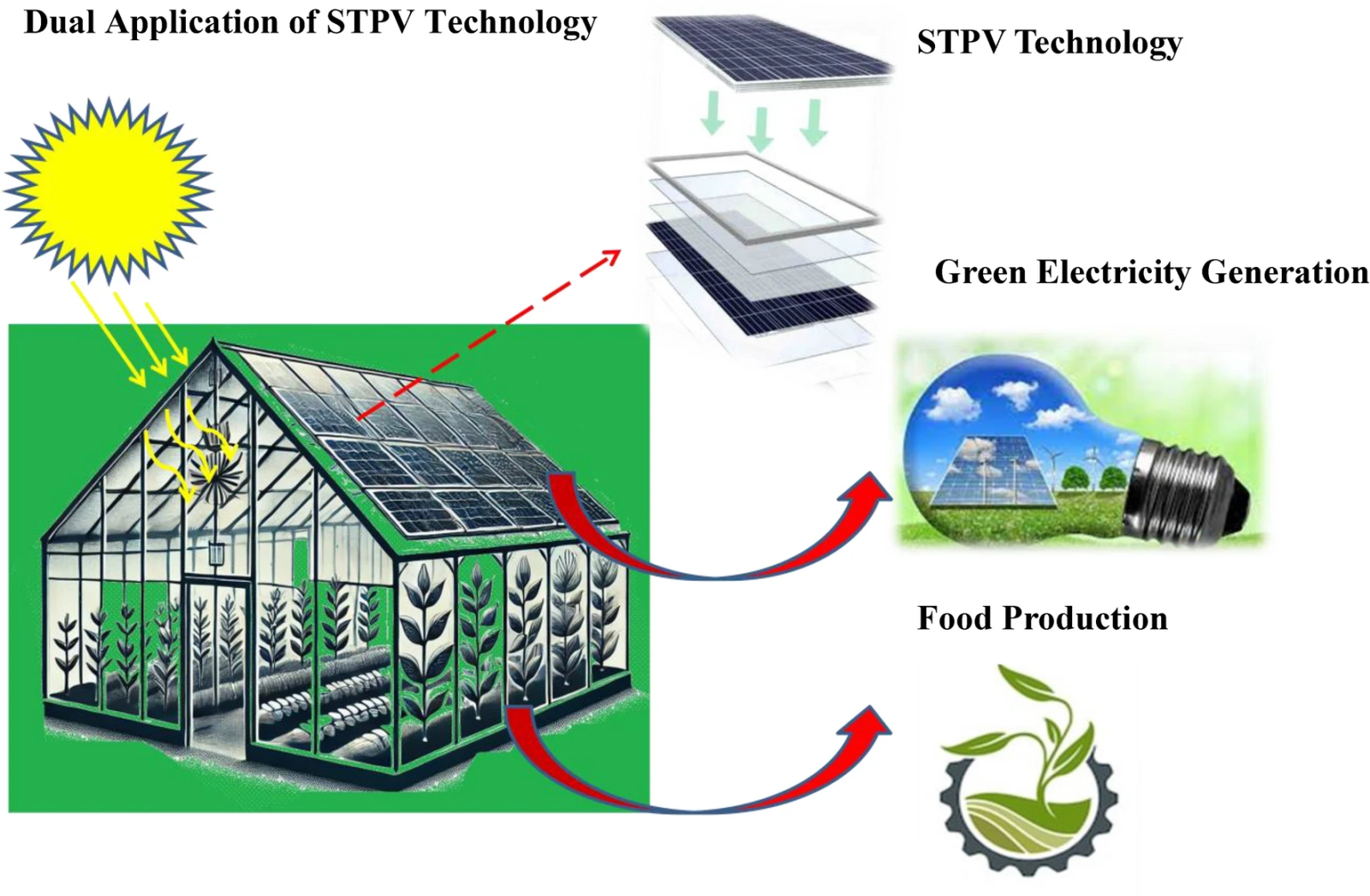
Figure | Dual application of STPV in a greenhouse.


