December 19, 2024 | Sensors |
Introduction: Automated greenhouse systems typically depend on fixed set-point controls that require skilled technicians for configuration and maintenance, limiting scalability and adaptability. Researchers from the University of Alicante and Miguel Hernandez University (Spain), together with the University of Costa Rica, proposed integrating Internet of Things (IoT) data acquisition with reinforcement learning (RL) optimization to automate and improve greenhouse climate control. The model was tested in a real industrial production greenhouse cultivating industrial hemp, guided by an agronomic technician whose expertise informed the RL transfer to the operational facility.
Key findings: The RL-based control system achieved energy savings of up to 45% during cooling and 25.93% during heating compared to traditional fixed set-point control, while maintaining temperatures within desired ranges. Energy savings increased at higher set-point temperatures, ranging from approximately 36% at 18°C to nearly 50% at 22°C. Among machine learning methods tested for indoor temperature prediction, gradient boosting and linear regression showed the lowest RMSE values. The integration of IoT enabled real-time data acquisition and seamless communication between greenhouse subsystems, allowing the RL model to adapt dynamically to changing environmental conditions. The approach reduces the need for constant human intervention, simplifying technician workloads and increasing scalability for larger agricultural enterprises. The authors noted that the model can be implemented using non-proprietary hardware and communication protocols in both existing and newly designed facilities, though further validation across diverse crops and climates is needed.
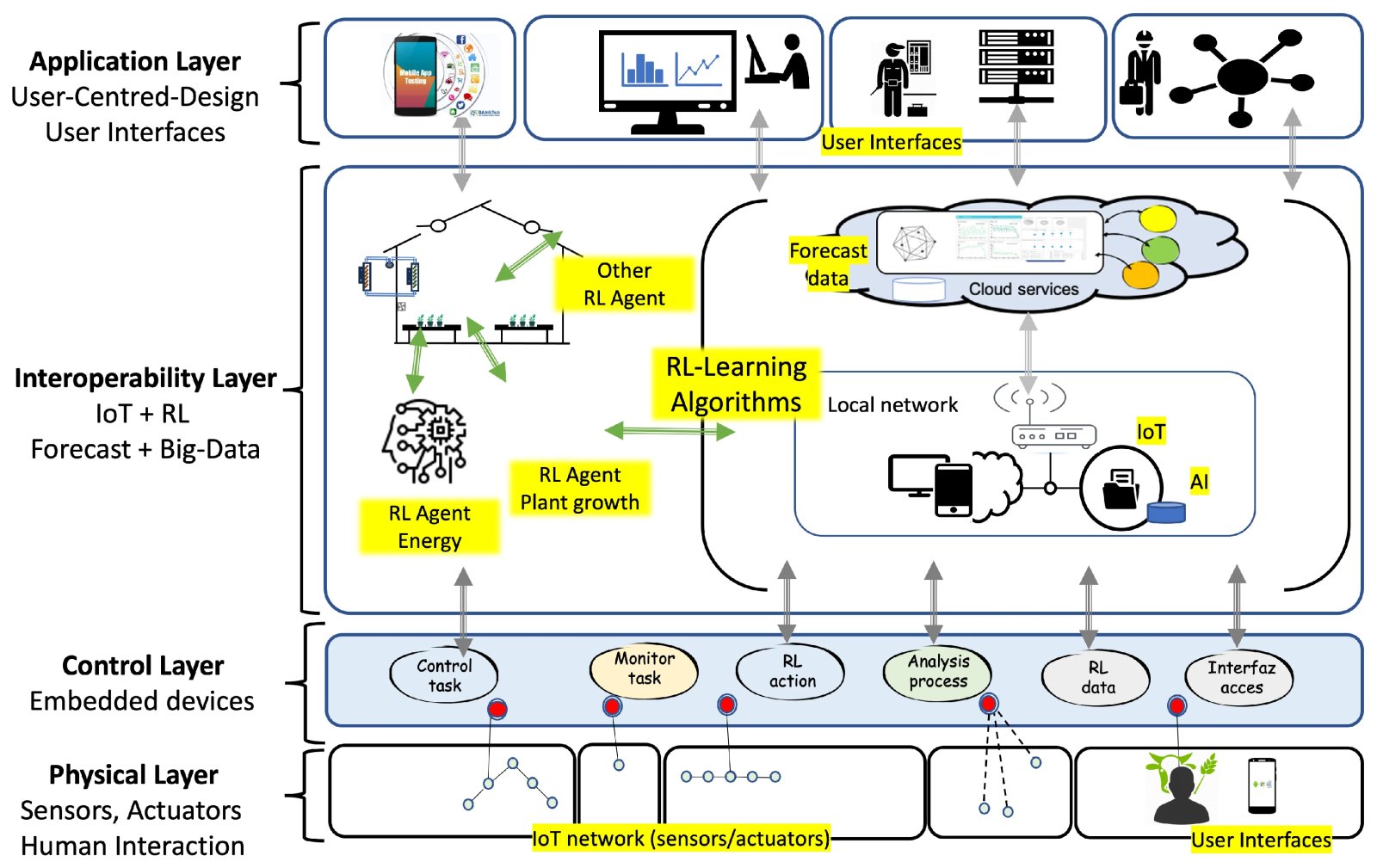
Figure | Layered technological architecture. Relationship between IoT, RL, digital platform and different interfaces.


