March, 2025 | Smart Agricultural Technology |
Introduction: In Bangladesh and many other smallholder farming economies, dependence on diesel pumps and unreliable grid electricity constrains the adoption of precision irrigation even as water scarcity intensifies. A researcher team at Bangladesh Agricultural University's Department of Farm Power and Machinery developed and tested a solar-powered IoT-based smart irrigation system that eliminates dependence on conventional electricity by integrating a 20W solar panel with a Raspberry Pi 4 base station and NodeMCU/ESP8266 substations, communicating via MQTT protocol and monitored through a responsive web interface accessible from any internet-connected device.
Key findings: The system uses capacitive soil moisture sensors and DHT22 temperature-humidity sensors to trigger automatic pump activation when soil moisture falls below 45% and deactivation at 80%, reducing unnecessary water use. The 12V DC battery stored 90W, sufficient to run the irrigation pump for over 5 hours; substations maintained operation for over 19 hours on a single lithium battery charge. Field testing over 9 months confirmed reliable wireless data transmission and pump control through more than 100 uninterrupted irrigation cycles. The responsive web interface provides real-time visualization and remote pump control from personal computers and mobile devices. Overall, the system demonstrates strong potential for smallholders across electricity-limited regions of South and Southeast Asia. Limitations include approximately ±2% timing delays in pump actuation, rain interference inflating soil moisture readings during wet periods, and the need for a larger pilot field with more appropriate pump specifications for full-scale evaluation. Future work should address expanded field-scale testing, advanced statistical performance analysis, and GUI enhancements for user experience.
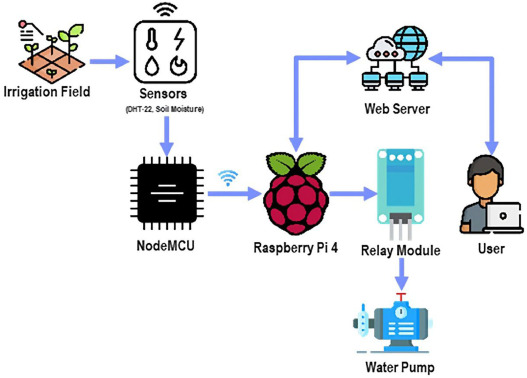
Figure | Architecture of the proposed system.


