October 30, 2024 | Smart Agricultural Technology |
Introduction: Farmers in the Mediterranean region face competing pressures of water scarcity and the high cost of smart irrigation technology, yet most commercial precision irrigation systems remain financially inaccessible at farm scale. Researchers at the CNR Institute of BioEconomy and CNR Institute of Geosciences and Earth Resources in Italy developed and field-tested a low-cost, fully automatic evapotranspiration-based smart irrigation system for tomato and melon production in Tuscany over 3 growing seasons (2021–2023).
Key findings: The system uses a satellite-derived evapotranspiration (ET) model (Agrosat) combined with growth-degree-day (GDD)-based crop coefficients to generate daily irrigation schedules, with LoRa/LTE connectivity, solar power, and an Arduino/Thinker Board control platform. Results across 3 seasons show a progressive refinement: in 2021, conventional irrigation applied 511 mm to tomato and 454 mm to melon. By 2023, the full smart ET-based system reduced water applied to 188 mm and 168 mm respectively, approximately 50% below conventional benchmarks, equivalent to reducing delivery from 3,000 to 1,800 m³/ha. Tomato yield at full irrigation reached 101.4 t/ha in 2021, with the 75% treatment achieving 63.1 t/ha under the best-performing conditions in 2023. Total system cost remained below €6,000 for a 700 m² pilot, with the control hardware being scalable at no additional cost to larger field areas. Key limitations include the absence of randomized plot design due to drip infrastructure constraints and phytosanitary complications in the final season. Future work will focus on validating GDD-based crop coefficients locally and scaling the system to larger commercial fields.
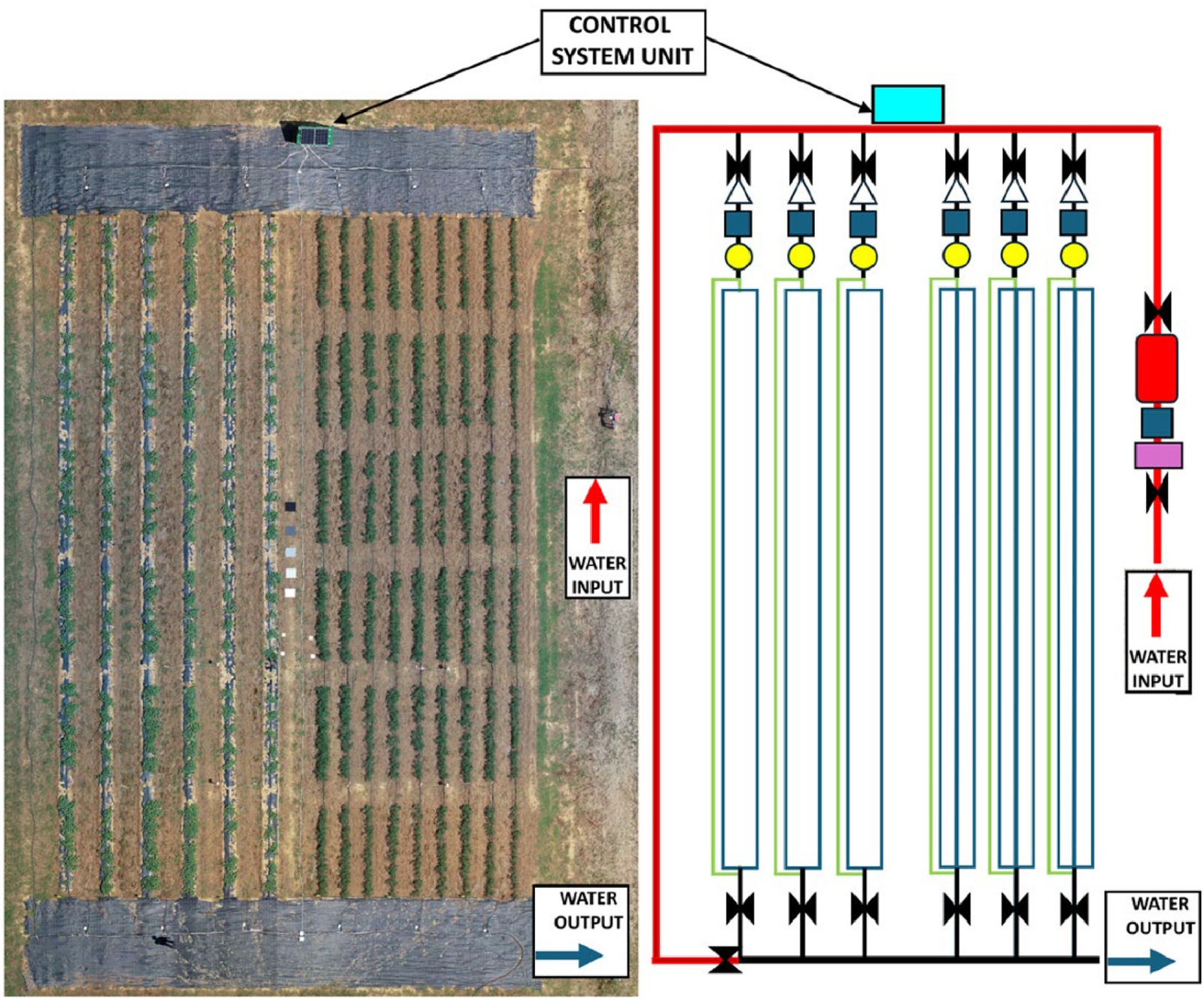
Figure | Diagram scheme of the smart irrigation system developed in the DATI Project, equipped with valves (black), filter (pink), pressure sensors (blue), expansion tank with pressure gauge (red), pressure regulators with manometers (white), digital litre counters (yellow).


