February 5, 2025 | Journal of Water and Climate Change |
Introduction: Climate change is intensifying water scarcity and disrupting seasonal rainfall patterns, particularly in tropical and smallholder farming systems where adaptive irrigation solutions remain limited or unaffordable. An Indonesian-led research team from IPB University and Sriwijaya University addresses this challenge through a comprehensive review of global irrigation water use efficiency (WUE) research. The study evaluates smart irrigation systems as a water management strategy and introduces evapotranspirative irrigation technology as a low-cost, electricity-free adaptive approach.
Key findings: The review identifies smart irrigation systems integrating sensors, automation, data analytics, drip and micro-irrigation, and weather-based scheduling as the most effective approach for improving WUE and productivity. However, high costs and technical complexity continue to limit adoption among smallholder farmers, particularly in Indonesia, where barriers include limited credit access, low technical capacity, cultural resistance, and unstable water availability caused by climate variability. As an alternative, the study highlights evapotranspirative irrigation technology, which delivers water based on actual crop evapotranspiration (ETc) without electricity. Field tests in Indonesia showed strong performance across multiple crops and settings, including 40% water savings in greenhouse applications and irrigation water productivity of 1,307.34 g/L in water lettuce cultivation. The most advanced system, FONi (Non-Powered Automatic Fertigator), achieved nearly 100% irrigation efficiency. The review notes the need for broader field-scale validation and stronger policy support for smallholder adoption.
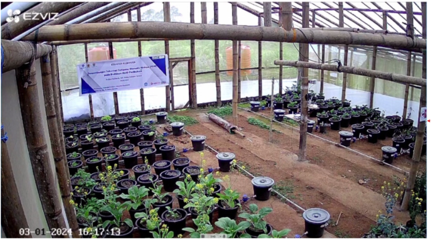
Figure | Example of FONi implementation on actual land.


