Search
Agentic artificial intelligence-driven digital twin for real-time irrigation control with fuzzy sustainability objectives
Sources of information

April 15, 2026 | IJOCTA |


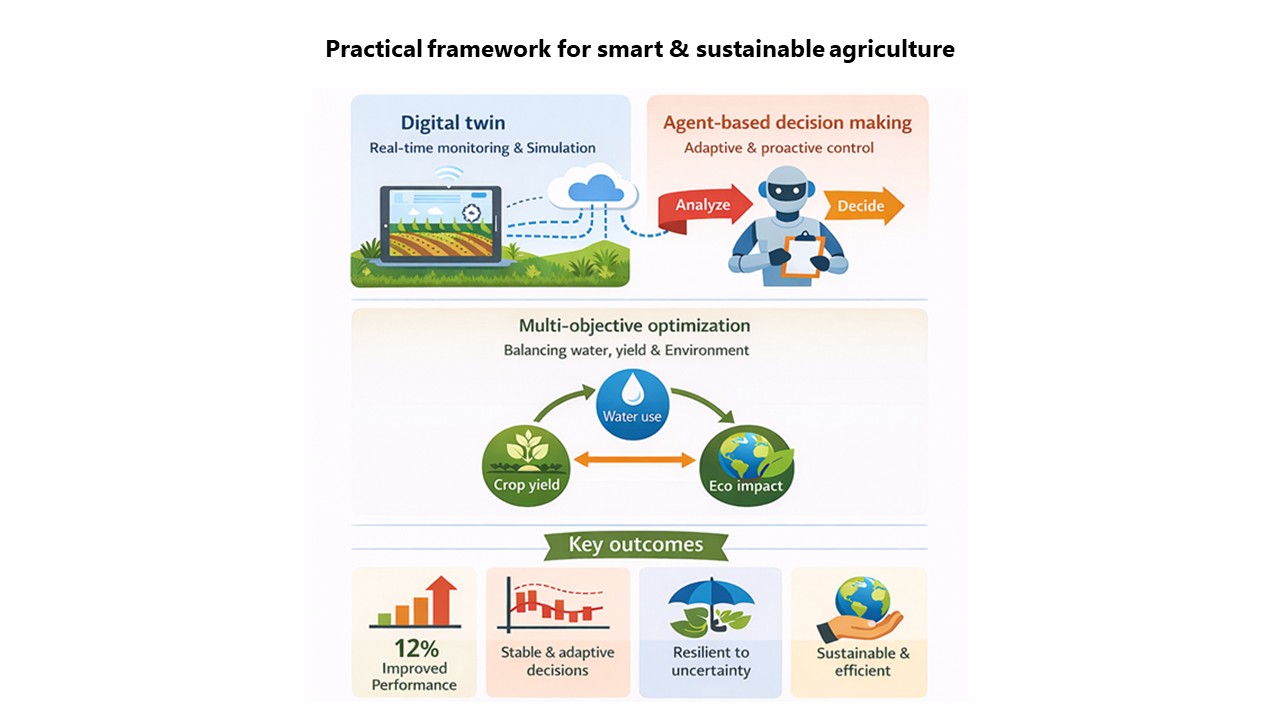
Introduction: Real-time irrigation management faces a fundamental challenge: existing frameworks typically use either static optimization models or reactive threshold-based controls, neither of which can simultaneously balance water conservation, crop yield, and environmental sustainability under dynamic conditions. Researchers from University of National and World Economy in Bulgaria addressed this gap by proposing an integrated framework that embeds a digital twin directly in a closed agent-based decision-making loop, using fuzzy multi-objective optimization to enable adaptive, real-time irrigation control validated against farm field data.


Key findings: The framework continuously updated with real soil moisture and weather sensor data, along with agent-based decision-making that follows a perception–analysis–decision–action cycle, and optimizes 4 objectives simultaneously: 1) crop growth stability, 2) water and energy minimization, 3) control fluctuation reduction, and 4) environmental compliance. Among 3 tested algorithms (NSGA-II, MOEA/D, MOPSO), NSGA-II achieved the highest hypervolume and greatest robustness across drought and extreme climate scenarios. Sensitivity analysis confirmed the framework maintains stable equilibria across parameter changes, with water consumption objectives showing the highest sensitivity. Key limitations include partial reliance on simulated data and a current scope limited to irrigation decisions, excluding fertilization and harvest timing. Future directions include multi-region field validation, extension to broader farm management decisions, and integration of adaptive learning for automatic parameter updating.


Graphical abstract
Viewed Articles
Agentic artificial intelligence-driven digital twin for real-time irrigation control with fuzzy sustainability objectives
April 15, 2026 | IJOCTA | Introduction: Real-time irrigation management faces a fundamental challenge: existing frameworks typically use either static optimization models or reactive threshold-based c
Read More
Methodologies of control strategies for improving energy efficiency in agricultural greenhouses
November 20, 2020 | Journal of Cleaner Production | Introduction: Greenhouses account for the largest share of final energy consumption in agriculture, with heating alone consuming 65-85% of total ene
Enhancing energy autonomy of greenhouses with semi-transparent photovoltaic systems through a comparative study of battery storage systems
January 17, 2025 | Scientific Reports | Introduction: Greenhouses require stable energy supplies for maintaining optimal environmental conditions, yet their heavy reliance on grid electricity increase
Recent climate-smart innovations in agrifood to enhance producer incomes through sustainable solutions
March, 2024 | Journal of Agriculture and Food Research |  Introduction: Climate change is undermining agrifood productivity and producer incomes, with small-scale farmers facing heightened exposure du
Smart breeding driven by big data, artificial intelligence, and integrated genomic-enviromic prediction
November 07, 2022 | Molecular Plant |  Introduction: Climate change and population growth necessitate a transition from traditional phenotypic selection to data-driven "smart breeding". A research tea
Enhancing climate change resilience in agricultural crops
December 04, 2023 | Current Biology |  Introduction: To ensure food security for a burgeoning global population, a 28% increase in global agricultural production is required over the next decade. Howe
TOP