Search
Smart irrigation monitoring and control strategies for improving water use efficiency in precision agriculture: A review
Sources of information

February 1, 2022 | Agricultural Water Management |


Introduction: This review, conducted by researchers from the University for Development Studies and Kwame Nkrumah University of Science and Technology in Ghana, examines the current state of smart irrigation monitoring approaches, including soil-based, weather-based, and plant-based methods. It further compares open-loop and closed-loop control strategies to identify the most suitable combinations for open-field applications.


Key findings: The review finds that water use efficiency improves most effectively when monitoring and control are integrated rather than managed separately. Closed-loop control systems consistently outperform open-loop alternatives, as open-loop systems cannot respond to real-world uncertainties in soil moisture conditions and crop responses. Among monitoring strategies, soil moisture sensors achieve water savings of 50–58.8%, depending on crop type and system configuration. Weather-based scheduling using evapotranspiration models achieves approximately 30% water savings in cantaloupe and greenhouse conditions, while plant-based approaches using the CWSI and NDVI indicators generate savings of 10–45%.

Among control strategies, Model Predictive Control (MPC) shows the strongest overall performance. However, most MPC studies remain at the simulation stage, with limited validation under real open-field conditions. Artificial neural networks (ANNs) reduce energy and water use by 20.5–23.9% in strawberry cultivation. The review recommends integrating soil, plant, and weather monitoring inputs within a discrete MPC framework for open-field applications. Key limitations include the lack of open-field dynamic models capable of handling uncertainties from soil variability and weather disturbances. Future research should prioritize the development and field evaluation of hybrid MPC approaches in real open-field environments.
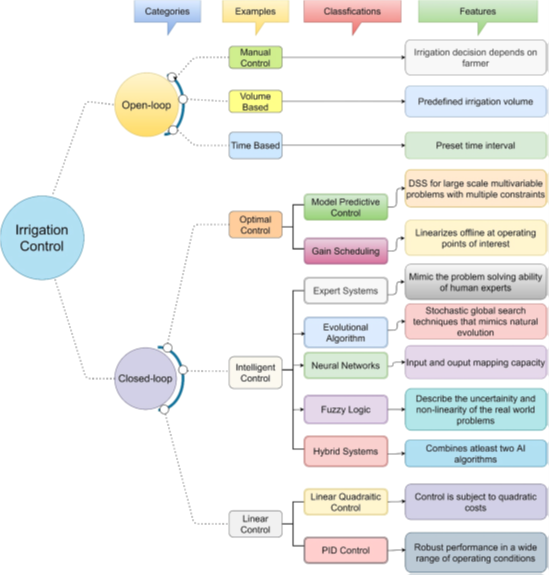
 

Figure | Classification of irrigation control strategies.

Viewed Articles
Smart irrigation monitoring and control strategies for improving water use efficiency in precision agriculture: A review
February 1, 2022 | Agricultural Water Management | Introduction: This review, conducted by researchers from the University for Development Studies and Kwame Nkrumah University of Science and Technolog
Read More
Recent climate-smart innovations in agrifood to enhance producer incomes through sustainable solutions
March, 2024 | Journal of Agriculture and Food Research |  Introduction: Climate change is undermining agrifood productivity and producer incomes, with small-scale farmers facing heightened exposure du
An integrated approach of remote sensing and geospatial analysis for modeling and predicting the impacts of climate change on food security
January 19, 2023 | Scientific Reports |  Introduction: Climate change threatens agriculture, infrastructure, and local communities. Monitoring and predicting climate impacts on food security is essent
Enhancing greenhouse efficiency: Integrating IoT and reinforcement learning for optimized climate control
December 19, 2024 | Sensors | Introduction: Automated greenhouse systems typically depend on fixed set-point controls that require skilled technicians for configuration and maintenance, limiting scala
Yield prediction through UAV-based multispectral imaging and deep learning in rice breeding trials
February, 2025 | Agricultural Systems |  Introduction: Accurate and timely yield prediction is critical for breeding trials, as it enables early elimination of poor-performing varieties and accelerate
Prediction-based breeding: Modern tools to optimize and reshape programs
October 09, 2025 | Crop Science |  Introduction: Traditional plant breeding often prioritizes explanatory models to understand biological mechanisms, which can limit the generalizability of selection
TOP