May 24, 2025 | Computers and Electronics in Agriculture |
Introduction: Timely and accurate monitoring of rice pests and diseases is essential for limiting production losses estimated at 10–30% of annual yield, yet conventional field survey methods remain labour-intensive and expert-dependent. Researchers at Zhejiang Sci-Tech University and the China National Rice Research Institute (CNRRI) propose an intelligent survey system combining wearable augmented reality glasses with a two-stage image-text multimodal detection model.
Key findings: The proposed RDP-Detector was tested on seven rice diseases and pests, achieving 87.4% mean average precision. Compared with image-only baseline models, precision improved by 14.6% points, demonstrating the measurable added value of combining visual and textual inputs. The AR glasses component provides meaningful practical advantages in real field conditions: hands-free operation reduces physical barriers during survey work, voice control allows device interaction without touching the screen, and the display remains clear under bright sunlight where conventional screens struggle. These features make the system more accessible for frontline agricultural workers in demanding outdoor environments. Beyond detection accuracy, the study demonstrates broader potential for wearable technology and multimodal AI in precision agriculture. More accurate, timely, and scalable pest diagnosis can help reduce unnecessary pesticide applications and support evidence-based crop protection decisions. The authors suggest that similar approaches could be extended to other crops and pest systems, offering a scalable model for intelligent field surveillance in climate-stressed agricultural landscapes.
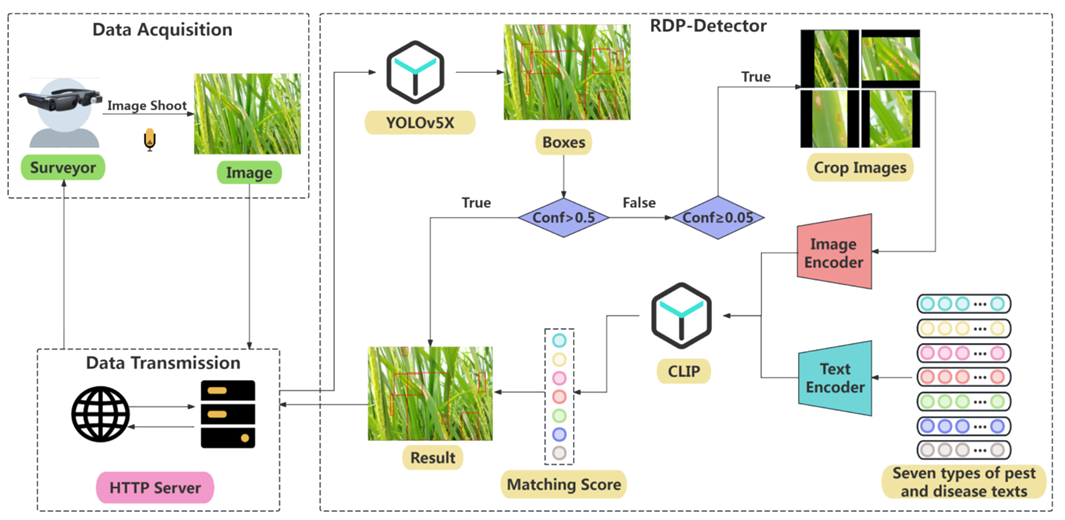
Figure | Roadmap of the AR glasses intelligent survey method technology.


