June 28, 2024 | Precision Agriculture |
Introduction: Climate change is compounding the challenge of plant disease management by shifting the conditions under which pathogens survive, spread, and cause damage. This review led by researchers at the Swedish University of Agricultural Sciences examines how Internet of Things (IoTs) sensors, machine learning (ML), and artificial intelligence (AI) are being integrated into disease forecasting systems for precision agriculture. The authors survey both data-based and process-based modelling approaches, assessing their capacity to handle climate-driven variability, and argue that the future of effective disease management lies in open, validated, and transparent AI models that can support timely decisions by farmers and agronomists.
Key findings: Digital forecasting systems now combine field sensors, remote sensing, satellite imagery, weather data, and biological knowledge to predict disease risks with greater accuracy than conventional methods. Early warning systems and disease-specific AI models enable farmers to identify risks earlier and time fungicide or other control applications more precisely, reducing unnecessary chemical use while protecting yields. The review highlights the growing use of IoT devices for continuous environmental monitoring, machine learning algorithms for pattern recognition in large datasets, and AI models that simulate complex host–pathogen–environment interactions. These tools are transitioning from research settings into practical farm applications, supported by improvements in connectivity, sensor affordability, and cloud computing. The authors position IoT, ML, and AI as key enablers of climate-resilient agriculture, supporting more efficient resource use, lower environmental impacts, and safer food production. Widespread adoption, however, requires investment in rural digital infrastructure, affordable access to technology, and capacity-building for farmers and extension workers to interpret and act on data-driven forecasts.
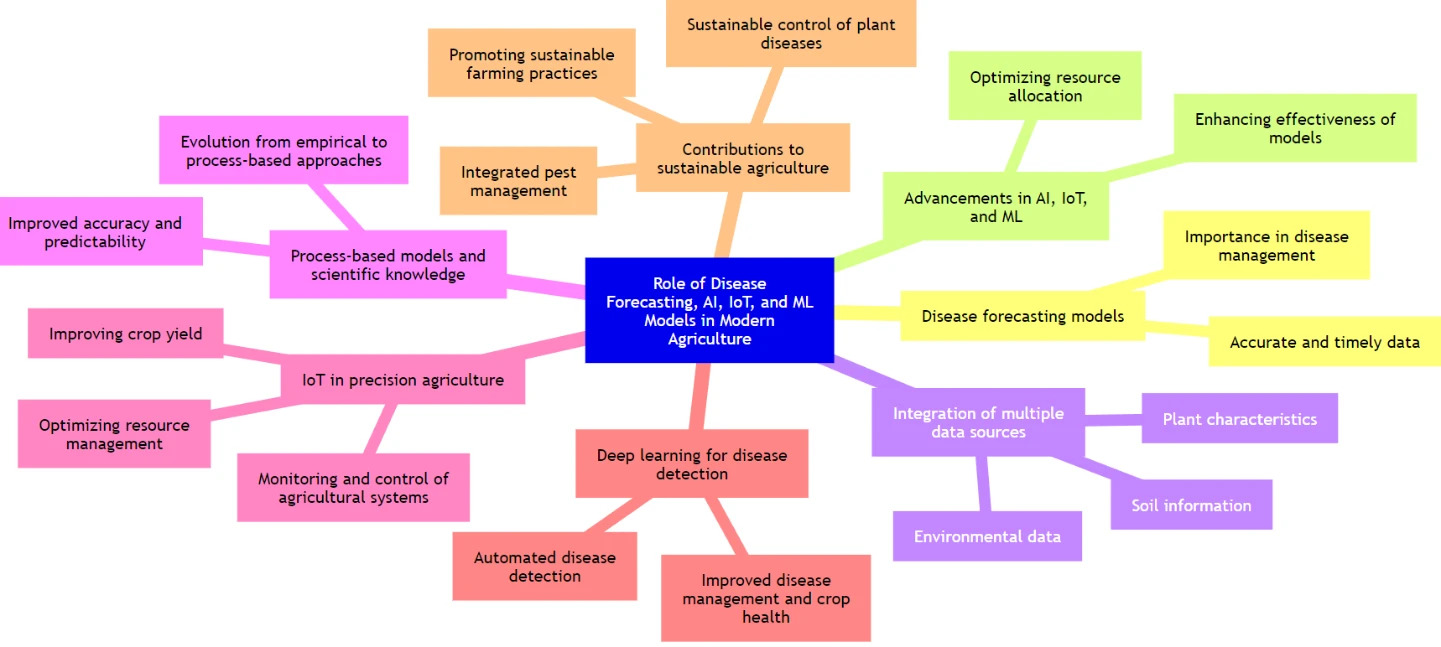
Figure | Diagram overview of the role of disease forecasting, AI, IoT, and ML models in modern agriculture.


