March 18, 2024 | Communications Biology |
Introduction: Despite the availability of environmentally friendly pest control options, uptake of green Integrated Pest Management (IPM) remains slow. A multinational research team across China, United States, Australia, and France identifies two structural weaknesses in current IPM practice: limited synergy among existing tactics, and a narrow focus on individual pests rather than the complex, multi-pest realities of real cropping systems. The study proposes a new theoretical framework to reorient IPM toward ecosystem-level thinking and improve adoption of sustainable pest control strategies.
Key findings: The Multi-Dimensional Management of Multiple Pests (3MP) framework considers both spatial and temporal dimensions of pest management. It connects soil health, crop systems, pest populations, and natural enemies, while accounting for the full range of pest interactions across different crop growth stages. This approach reframes IPM from a single-pest strategy to an ecosystem-centered system capable of managing multiple pests and pathogens simultaneously. To evaluate whether control strategies are truly effective, the study also proposes a Performance–Economy–Environment (PEE) assessment tool. This three-part evaluation considers whether a strategy is agronomically effective, economically viable, and environmentally sustainable—enabling farmers and advisors to make more balanced decisions about which IPM tools to adopt. By integrating biological control, resistant varieties, and non-chemical methods within this broader framework, 3MP offers a pathway toward lower pesticide use, stronger biodiversity protection, and more climate-resilient agriculture. The authors argue that shifting from crop-centered to ecosystem-centered pest management is essential for improving both adoption rates and long-term performance of green IPM.
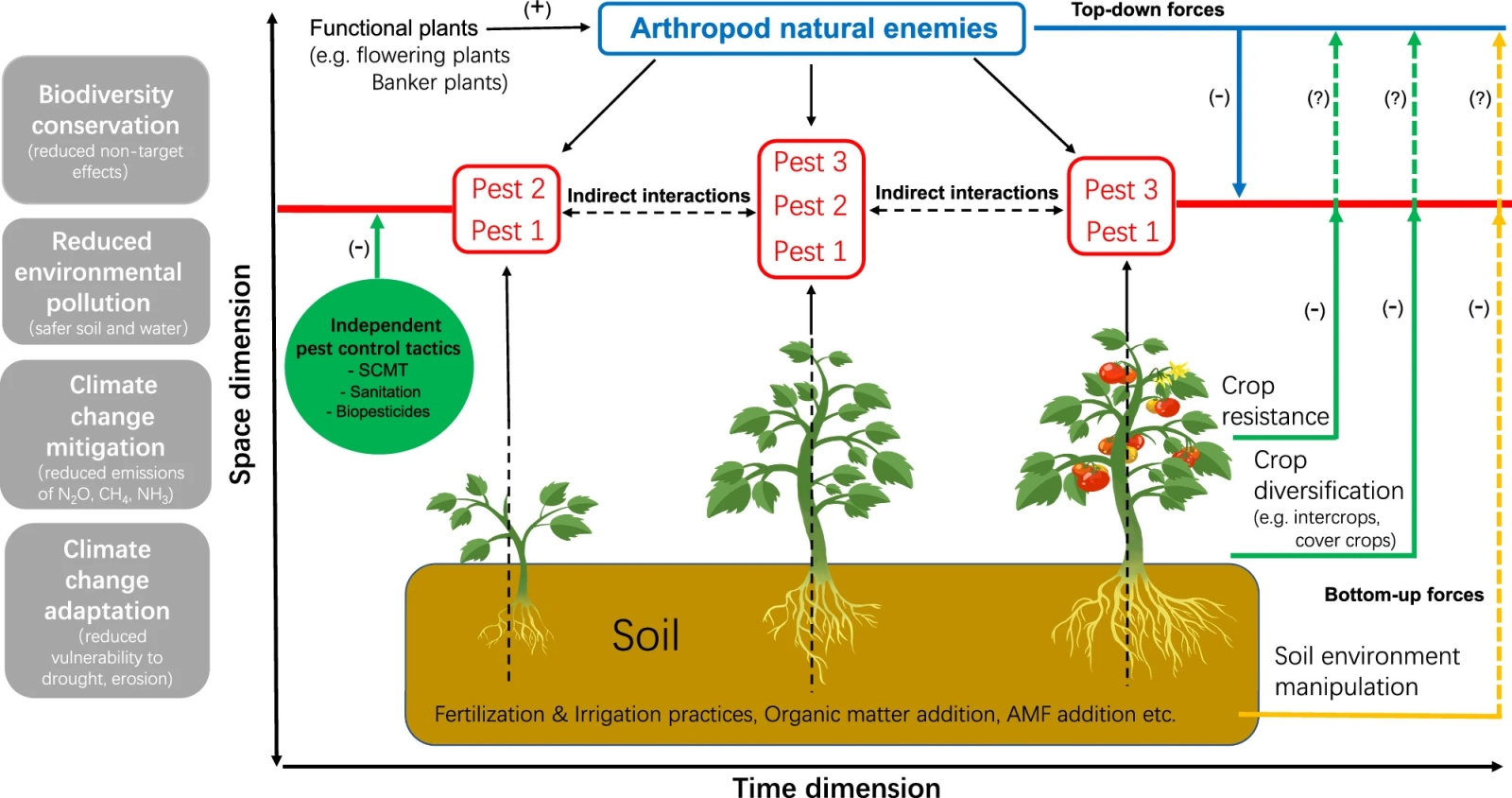 Figure | A new theoretical framework–Multi-Dimensional Management of Multiple Pests (3MP)– enabling a nuanced and holistic approach to the management of multiple pests across the cropping season.


