April 8, 2025 | Nature Reviews Earth & Environment
Introduction: This review led by researchers at Hebei University and the Chinese Academy of Agricultural Sciences (CAAS) explains how global change is rapidly reshaping crop pest threats. Despite a broader decline in insect biodiversity, many agricultural pests are becoming more damaging as they adapt to warming temperatures, simplified landscapes, and expanding global trade.
Key findings: Warming temperatures are pushing many pests toward higher latitudes and elevations, advancing their seasonal activity, and increasing the number of generations they produce each year. Under a 2°C warming scenario, pest-related yield losses are projected to rise sharply for wheat, rice, and maize. Agricultural intensification compounds these risks: fertilization, irrigation, and simplified landscapes provide better resources for pests while weakening natural enemies that help suppress outbreaks. International trade further accelerates the spread of invasive species. The review highlights how land-use changes interact with climate drivers to alter pest–natural enemy dynamics in complex, difficult-to-predict ways. In response, the authors advocate for climate-smart pest management (CSPM) integrating climate forecasting, landscape diversification, biological control, resistant crop varieties, and digital tools including artificial intelligence, drone surveillance, and sensor networks. They frame pest management as a critical strategy not only for protecting yields, but also for reducing unnecessary pesticide use and building long-term agricultural resilience.
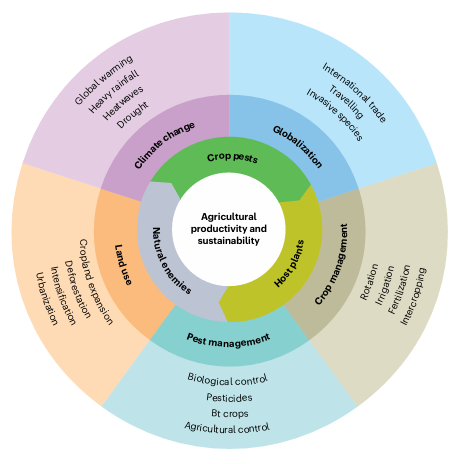
Figure | Global change drivers impacting crop pests.


