February 25, 2019 | Journal of Pest Science |
Introduction: Climate change is intensifying crop pest threats globally, disrupting species distribution, outbreak timing, and pest–natural enemy dynamics. Researchers at CABI argue that pest management must become a core pillar of climate-smart agriculture (CSA). With up to 40% of global food production already lost to pests, climate-driven pressures risk increasing pesticide use, raising emissions, and weakening ecological resilience.
Key findings: Climate-smart pest management (CSPM) promotes proactive, locally adapted practices including crop diversification, resistant varieties, biological control, habitat management, conservation tillage, and early warning systems to prevent outbreaks and enable timely responses. Farm-level action alone is insufficient; effective CSPM requires coordination across farmers, extension services, researchers, policymakers, and the private sector. Extension systems need strengthening, research institutions must build diagnostic capacity, and governments must provide supportive policies and financial incentives.
Well-implemented CSPM yields co-benefits: reduced yield losses improve food security and farm income, while lower pesticide use supports biodiversity, soil carbon, and reduced emissions. Key barriers include knowledge gaps, funding shortfalls, weak extension services, and context-specific challenges. The authors call for cross-sectoral collaboration to mainstream CSPM into global agricultural and climate policy.
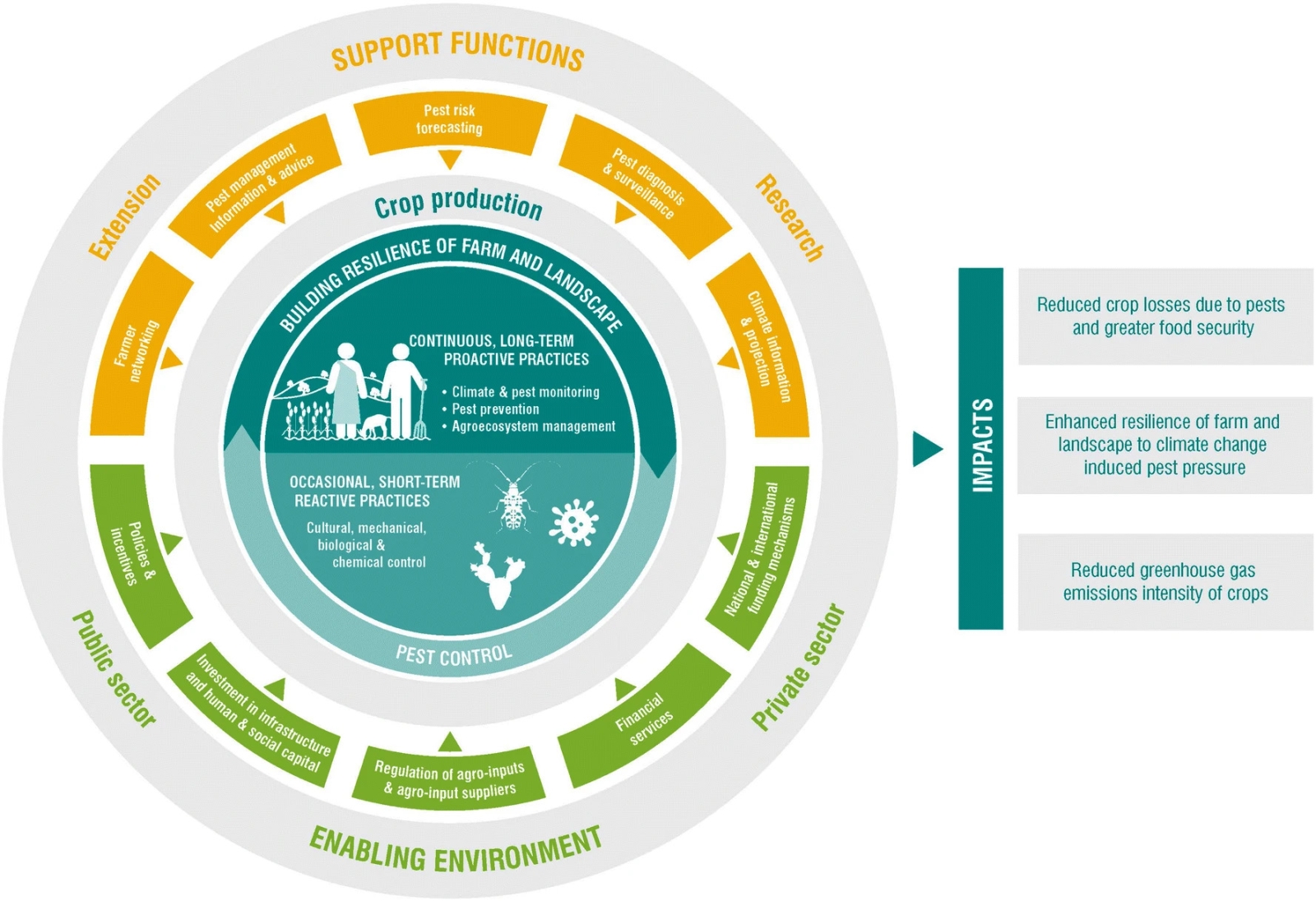
Figure | Climate-smart pest management (CSPM) is an interdisciplinary approach aiming to increase resilience of farms and landscapes to changing pest threats, mitigate greenhouse gas emissions and contribute to food security.


