January 15, 2024 | Agricultural and Forest Meteorology |
Introduction: Claims that climate-smart agricultural practices sequester atmospheric carbon more effectively than conventional approaches lack robust empirical grounding, partly because most studies rely on soil core sampling alone and rarely confirm that observed carbon gains reflect actual atmospheric uptake rather than erosion reduction. To address this, researchers from the USDA Agricultural Research Service combined eddy covariance flux towers, which continuously measure net carbon exchange between the field and the atmosphere, with deep soil cores extending to 1 meter to compare soil organic carbon (SOC) change between an aspirational field (no-till corn-soybean-wheat-hay rotation with cover crops) and a business-as-usual field (conventional tillage, corn-soybean-soybean rotation) from 2016 to 2022.
Key findings: Both measurement methods confirmed that the aspirational field accumulated more soil organic carbon than the business-as-usual field. Soil core estimates showed a ΔSOC of 1.9 ± 1.7% yr⁻¹ at the aspirational field versus −0.7 ± 1.3% yr⁻¹ at the conventional field; eddy covariance estimates were more conservative at 0.80 ± 0.09% yr⁻¹ and 0.12 ± 0.06% yr⁻¹ respectively, reflecting different measurement scopes. Unharvested cover crops added carbon during fallow periods that would otherwise represent net losses. No-till management and expanded rotations also contributed positively to the carbon budget. Critically, sampling to 1 meter depth was essential to capturing net SOC change: shallow sampling to 30 cm, the most common approach in the literature, would have underestimated carbon gains in the aspirational system where conservation practices redistribute carbon deeper in the profile. The study illustrates that combining soil sampling with eddy covariance provides a more complete picture of carbon dynamics, and underscores the value of this dual approach for verifying climate-smart practice outcomes, relevant to emerging MRV frameworks for agricultural carbon.
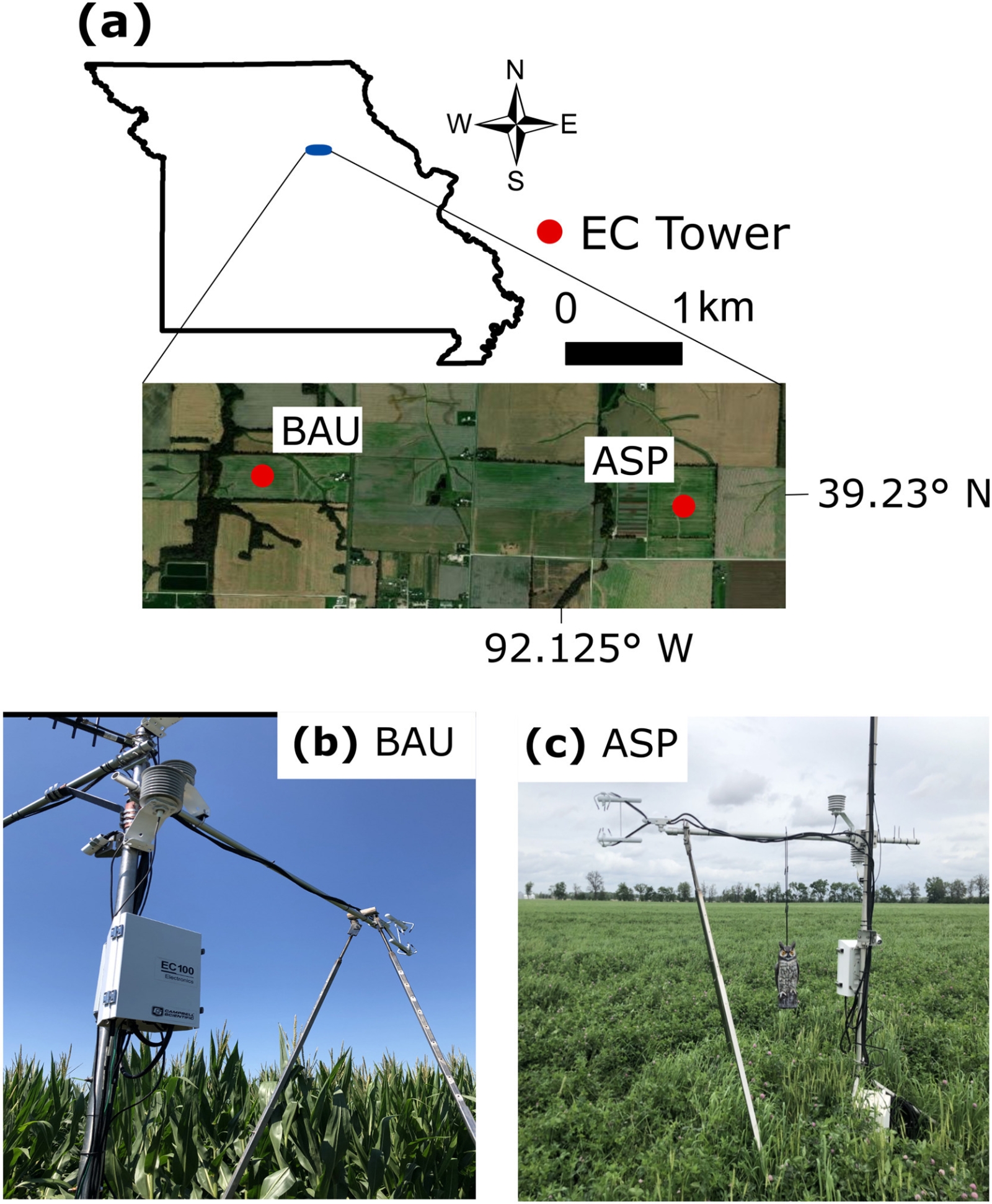
Figure | The (a) two study fields located within central Missouri, USA are instrumented with eddy covariance systems at the (b) business-as-usual (BAU) field (July 24, 2020) and (c) spirational (ASP) field (May 25, 2021).


