March 11, 2026 | European Journal of Soil Science |
Introduction: Autonomous field robots are gaining attention as a tool for sustainable crop management, with mechanical weeding currently their dominant application. Yet their effects on soil health beyond weeding efficiency remain poorly understood. Researchers from the Leibniz Centre for Agricultural Landscape Research (ZALF) and the Leibniz Institute for Agricultural Engineering and Bioeconomy (ATB) in Germany conducted a scoping review to synthesize evidence on how autonomous mechanical weeding robots affect soil functions and their role in climate-smart soil management.
Key findings: Of 22 studies reviewed, 18 focused on productivity-related outcomes such as weeding efficiency, while only five quantified effects on soil physical, hydrological, or biogeochemical functions. The review proposes a framework in which robots affect soil functions through two pathways: altered machinery intensity and traffic patterns, and repeated shallow soil disturbance from mechanical weeding interventions. Lighter robot axle loads relative to conventional tractors reduce compaction risk, but the second pathway, cumulative repeated shallow soil disturbance, poses underexamined risks to aggregate stability, carbon sequestration, and water regulation that could offset gains from reduced machinery weight. These effects remain largely unquantified across existing studies. Autonomous robotic systems could support diversified cropping systems and precision soil management, but current evidence is skewed and fragmented. The authors identify multiannual evaluation of soil property changes and continuous soil monitoring as research priorities needed to align robotic weeding with EU soil health targets and global sustainability goals.
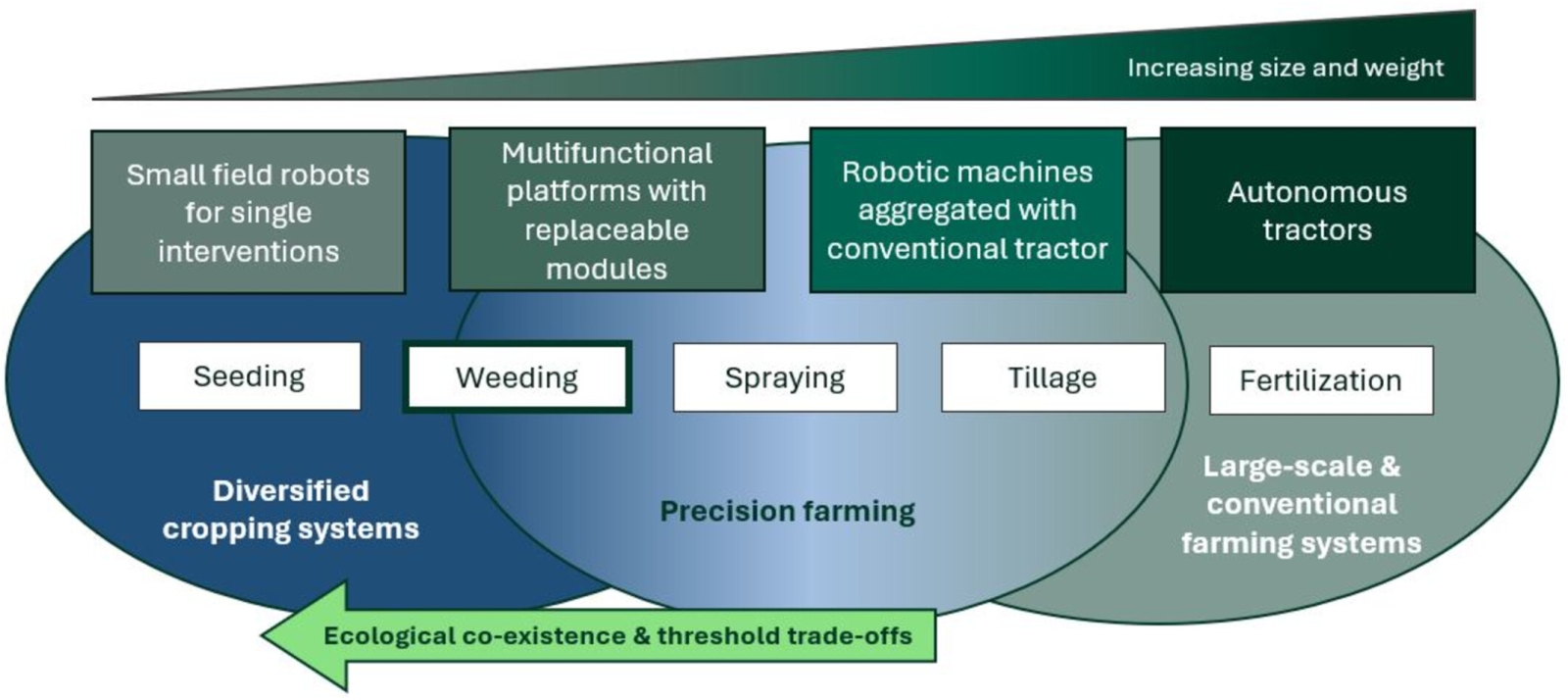
Figure | Conceptual classification of available agricultural robotic technologies (green boxes) in arable farming and their respective feasible management interventions (white boxes), embedded in their potential operational area for different cropping systems (circles).


