May 8, 2024 | PLOS ONE |
Introduction: Assessments of cover crop climate value typically quantify carbon sequestration and N₂O emissions, but omit land-use effects, specifically the carbon savings that arise when yield gains on existing cropland reduce pressure to convert natural land elsewhere. Focused on Central European maize cropping systems, researchers from Weihenstephan-Triesdorf University of Applied Sciences and Leibniz University Hannover in Germany conducted a systematic literature review to build a comprehensive framework for calculating the net climate change mitigation impact (NCCMI) of cover crops in this regional context.
Key findings: Cover crops generate a net climate change mitigation impact of 3.30 Mg CO₂e ha⁻¹ yr⁻¹. The largest contributor is carbon land benefit, which represents the avoided land-use emissions from higher maize yields, accounting for 34.5% of total benefits, followed by soil carbon sequestration at 33.8%. Climate costs, dominated by seed production emissions and foregone land-use benefits from seed area, represent only 15.8% of benefits. All four scenario variants tested returned a positive NCCMI. Scaling to the full EU-27 maize area, universal adoption of cover crops before maize would deliver 49.80 million Mg CO₂e yr⁻¹ in climate mitigation, equivalent to 13.0% of the EU's total agricultural emissions. The study notes that its framework is specific to Central European maize rotations and that extrapolation to other crop systems and regions will require adjusted parameters.
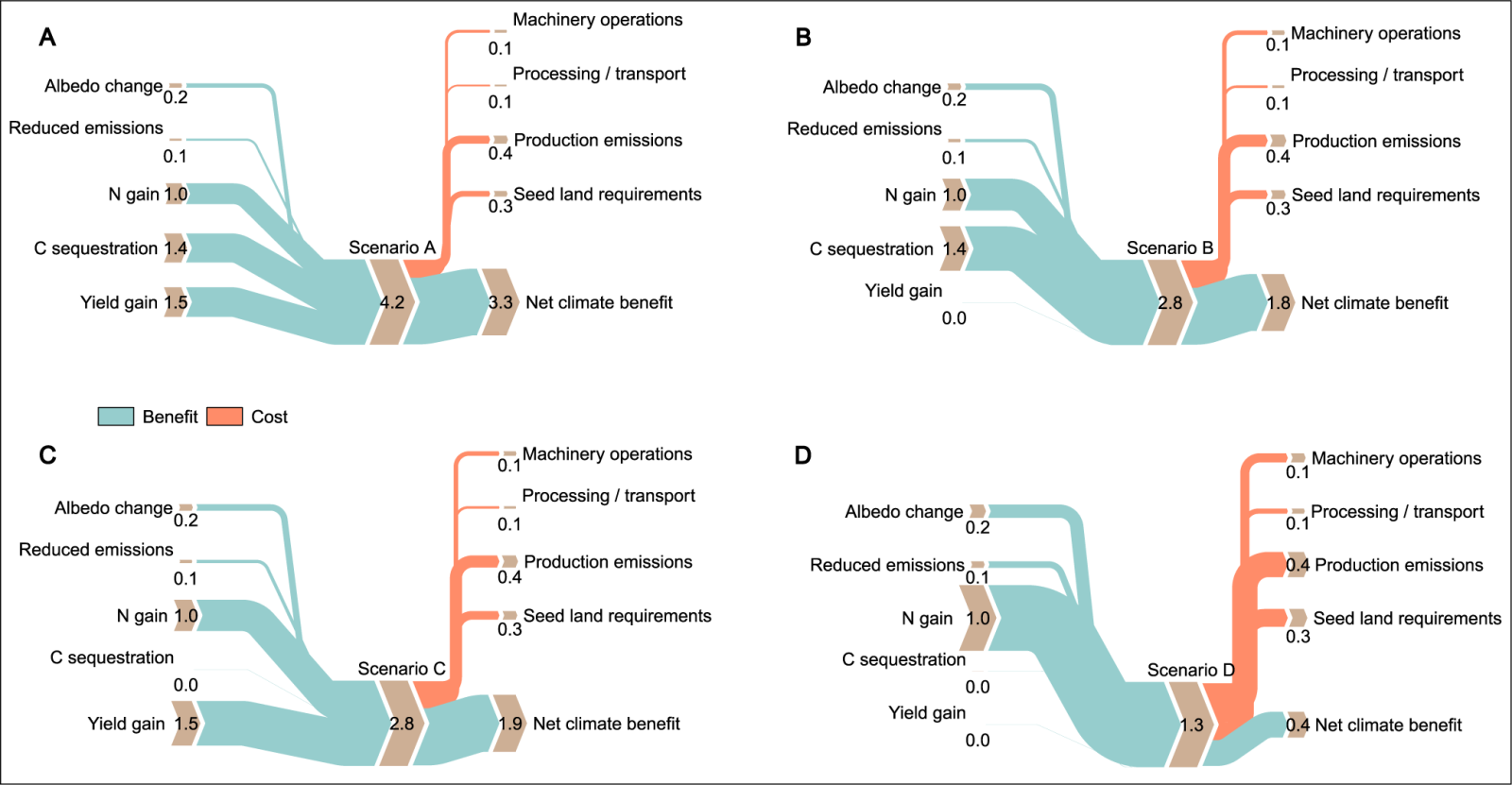
Figure | Sankey plots describing gains and losses of different scenarios for the NCCMI. (Numbers are given as Mg CO2e ha-1.)


