Search
Optimizing cover crop practices as a sustainable solution for global agroecosystem services
Sources of information

November 14, 2024 | Nature Communications |


Introduction: Cover crops offer multiple agroecosystem benefits including higher yields, soil carbon storage, and erosion control, but their net value is constrained by GHG trade-offs and variable outcomes across environments. A Chinese researcher team led by the Chinese Academy of Sciences analyzed 2,302 field observations from 219 studies spanning 1978 to 2020 to identify the optimal cover crop management portfolio and quantify its potential benefits for global agroecosystems.


Key findings: Historical cover crop use increased yields by 2.33%, soil organic carbon stocks by 6.46%, and soil aggregate stability by 14.3%, but also raised Nâ‚‚O and CHâ‚„ emissions by 29.5% and 42.3% respectively. A biculture of legume and non-legume cover crops, terminated 25 days before the next planting and followed by residue mulching, emerged as the optimal combination. Long-term implementation of five or more years, paired with no-tillage, converts these trade-offs into synergistic gains. Optimized practices are projected to increase agroecosystem multiservice by 1.25% globally, equivalent to annual gains of 97.7 million metric tons in crop production, 21.7 billion metric tons in COâ‚‚ sequestration, and 2.41 billion metric tons in soil erosion reduction. Benefits are largest in arid regions and least-developed countries, where adoption remains limited by farmer knowledge gaps and insufficient policy incentives. The authors call for international assistance and targeted subsidy schemes such as nitrogen credit systems and green manure planting programs to accelerate adoption in countries where cover crop potential is highest but institutional support is weakest.
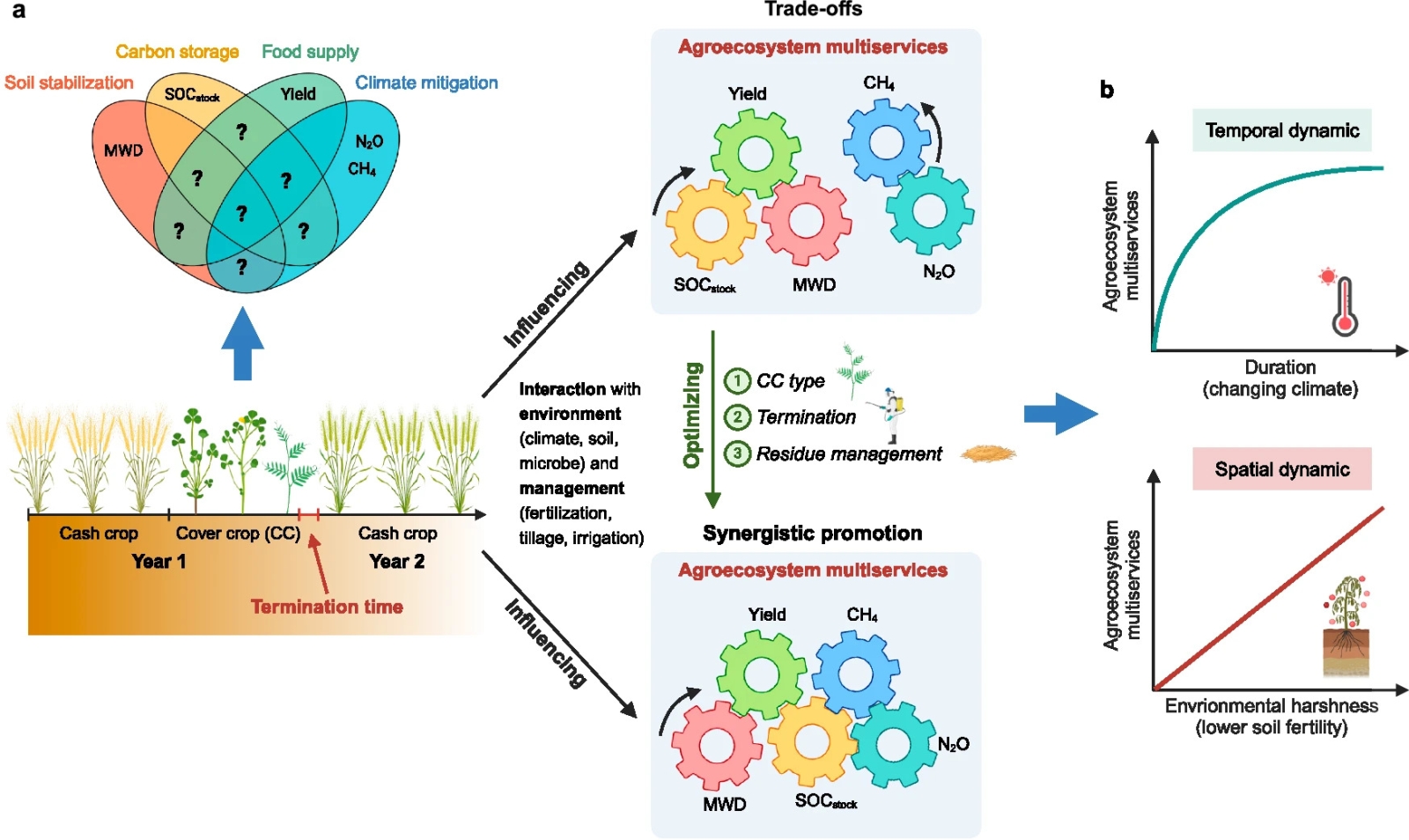
 

Figure | Hypothetical synergy of optimizing CC practices on multiple agroecosystem services, and its underlying benefits in different scenarios. 

Viewed Articles
Optimizing cover crop practices as a sustainable solution for global agroecosystem services
November 14, 2024 | Nature Communications | Introduction: Cover crops offer multiple agroecosystem benefits including higher yields, soil carbon storage, and erosion control, but their net value is co
Read More
Greenhouse gas emissions and carbon sequestration in organic dehesa livestock farms. Does technical-economic management matters?
October 20, 2022 | Journal of Cleaner Production | Source |  Introduction: While organic livestock systems are often hailed as environmentally friendly, their greenhouse gas (GHG) emissions and carbon
Potential soil organic carbon sequestration vis-a-vis methane emission in lowland rice agroecosystem
August 26, 2023 | Environmental Monitoring and Assessment |  Introduction: Lowland rice systems present a well-known climate trade-off, as management practices that increase soil organic carbon (SOC)
The role of autonomous mechanical weeding robots in climate-smart soil management: A scoping review
March 11, 2026 | European Journal of Soil Science | Introduction: Autonomous field robots are gaining attention as a tool for sustainable crop management, with mechanical weeding currently their domin
Salt marsh restoration: an overview of techniques and success indicators
January 6, 2022 | Environmental Science and Pollution Research | Source |  Introduction: Salt marshes are vital coastal ecosystems that support biodiversity, store carbon and protect shorelines. Yet,
Carbon sequestration via shellfish farming: A potential negative emissions technology
January, 2023 | Renewable and Sustainable Energy Reviews | Source |  Introduction: Achieving global climate goals requires practical, low-energy negative emissions technologies (NETs). Researchers fro
TOP