March 9, 2025 | Computers and Electronics in Agriculture |
Introduction: Declining natural pollinators due to climate change, habitat loss, and pesticide use threaten yields of pollination-dependent tree fruit crops. Researchers from Washington State University (USA) developed and field-tested a robotic pollination system for apples, integrating a machine-vision system to detect flower clusters with a robotic manipulator and electrostatic sprayer applying charged pollen suspension. The system was evaluated in lab conditions and then in commercial Honeycrisp and Fuji apple orchards, benchmarked against natural pollination.
Key findings: The machine-vision system achieved a mean average precision of 0.89 in identifying flower clusters, with an operational cycle time of 6.5 seconds per cluster. In Honeycrisp apples, robotic pollination at 2 g/l pollen concentration achieved a fruit set of 34.8% of sprayed flowers (87.5% of clusters with at least one fruit), versus 43.1% (94.9% of clusters) under natural pollination. In Fuji apples, performance dropped markedly — 7.2% fruit set (20.6% of clusters) versus 33.1% (80.6% of clusters) naturally — indicating cultivar-specific factors such as tree canopy structure and orchard age affect outcomes. Fruit quality (color, weight, diameter, firmness, soluble solids, starch content) was comparable between methods regardless of the fruit-set gap. The authors conclude robotic pollination is a promising, if still developing, supplementary strategy for orchard pollination, and call for further refinement of machine vision, spray parameters, and cultivar-specific calibration before broader field deployment.
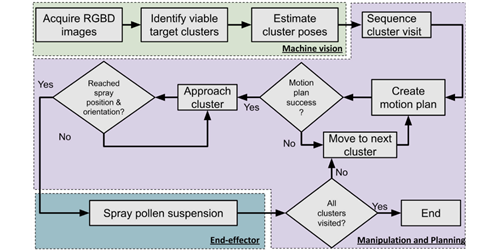
Figure | Overall flowchart of the proposed robotic pollination system. The system included a machine vision system with a RGB-D camera and image processing pipeline, alongside a mechatronic system with robotic manipulator, motion planning algorithms and an electrostatic sprayer-based end-effector system.


