February 2023 | Trends in Ecology & Evolution |
Introduction: Pollination research has historically focused on bees and globally traded crops, leaving the contribution of non-bee pollinators and locally important crops unclear. This study led by French researchers from Université Paris-Saclay reviewed 154 published studies on floral visitors across 83 crops, spanning 39 countries, to assess the diversity, conservation status, and role of bee and non-bee pollinators for crops of global market importance versus crops of local cultural, nutritional, and economic value.
Key findings: After excluding 67 studies (44%) that sampled bees only, the review found bees accounted for 91% of recorded pollinator occurrences, followed by Diptera (67%), Lepidoptera (44%), Coleoptera (33%), non-bee Hymenoptera (25%), and Hemiptera (18%); bats and birds also contributed, especially to tropical crops. Non-bee pollinators were more frequent visitors of locally important crops than globally traded ones, and were the only recorded floral visitors for crops including banana, calabash, langsat, petai, and snake gourd. The authors conclude that securing yield for locally important crops cannot rely on bees alone. They flag that nocturnal pollinators remain especially understudied due to diurnal-biased sampling — for example, 27 coleopteran and 6 lepidopteran species were identified as potential nocturnal pollinators of oilseed rape, sunflower, ridge gourd, and bottle gourd, yet current monitoring methods rarely capture them — and call for expanded monitoring of non-bee population trends, resilience to land-use change, and contribution to local food security, particularly in the Global South.
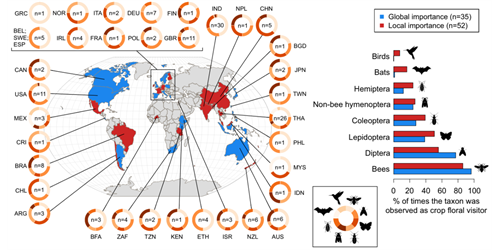
Figure | Global synthesis of crop pollinators reveals shared high-level diversity of non-bee species, including not only Diptera, Coleoptera, Lepidoptera, non-bee Hymenoptera, Hemiptera, but also non-insect pollinators, such as bats and birds, with differences between species groups for crops with global food market importance and those of importance for local people.


