June 27 2022 | Nature Sustainability |
Introduction: Whether ecological intensification (EI) can maintain crop yields while reducing reliance on nitrogen fertilizer (NF) and tillage intensity (TI) has lacked robust long-term evidence. An international, interdisciplinary research group applied meta-analysis to data from 30 long-term experiments across Europe and Africa, comprising 25,565 yield records, to test how EI practices, specifically increasing crop diversity and adding fertility crops and organic matter, interact with NF and TI in shaping staple crop yields.
Key findings: EI practices generally had positive effects on staple crop yields, confirming their viability as a sustainable pathway. EI's yield benefit was largely substitutive with nitrogen fertilizer: EI substantially increased yield at low NF doses but had minimal effect at high NF doses, indicating an optimal NF level that is generally lower where EI is applied. Manure had the strongest substitution effect, allowing most or all NF to be removed without yield loss. Reducing tillage intensity produced, on average, a statistically significant 4% yield reduction — small relative to overall yield variability in the dataset, though outcomes varied by tillage type (e.g., basins performed slightly better than more intensive tillage, while shifting to zero-till slightly reduced yields). Crop residue retention showed no measurable effect on yield. The authors conclude EI can contribute meaningfully to future sustainable farming systems, particularly where synthetic fertilizer use is reduced, though effects vary by context and further long-term trials are needed to resolve tillage-related uncertainty.
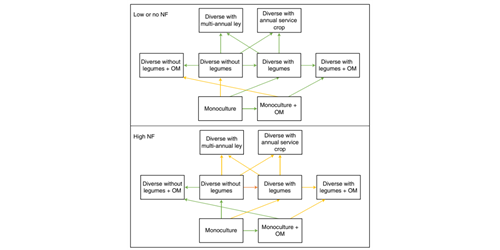 Figure | A summary of the EI practices and combinations thereof that increase yields, have no effect on yields or may risk a yield decrease when implemented in either a low or high NF context.


