Search
Improving ecosystem services in farmlands: beginning of a long-term ecological study with restored flower-rich grasslands
Sources of information

June 20, 2022 | Ecosystem Health and Sustainability |


Introduction: Grassland restoration research lacks landscape-scale studies, long-term monitoring of successional processes, and diverse native seed mixtures, particularly in Central and Eastern Europe. A Hungary-based research team led by the Centre for Ecological Research launched a long-term field experiment in 2020 to address these gaps. The study established 0.5 ha wildflower parcels using 32 local insect-visited plant species across 24 circular landscape plots (500 m radius) in Central Hungary, with homogeneous and heterogeneous landscape contexts, to test landscape-scale effects of restoration on crop yield, pollination, and pest control.


Key findings: Two years after establishment, sown vegetation shifted from weed-dominated cover in year one to the target flowering species in year two, and the parcels are now attracting a diverse pollinator community, including wild bees and butterflies. The monitoring protocol combines biannual botanical surveys with pollinator transects and malaise traps in late May and late July, trap-nests for cavity-nesting bees and wasps placed at 80 m intervals up to 400 m from each plot to capture landscape-scale effects, and pan traps (24 per plot, 576 in total) exposed for 48 hours each July. As a "beginning" narrative, the paper reports study design and early establishment rather than statistical yield or biodiversity outcomes; those results will accumulate through continued monitoring. The authors intend the protocol as a replicable model demonstrating that diversified farmland can maintain yield while restoring biodiversity, feeding evidence into policy frameworks such as the EU Green Deal and the UN Decade on Ecosystem Restoration. 
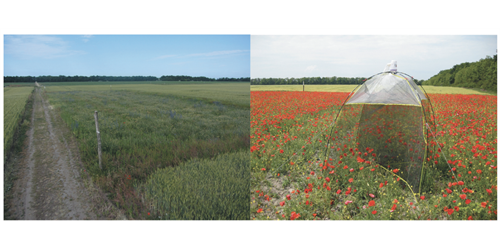
 

Figure | The overview of a wildflower strip in a homogeneous landscape (left) shows its island-like setting. A malaise trap is set out for a week in one of the wildflower parcels and targets most flying insects (right). 

Viewed Articles
Improving ecosystem services in farmlands: beginning of a long-term ecological study with restored flower-rich grasslands
June 20, 2022 | Ecosystem Health and Sustainability |Introduction: Grassland restoration research lacks landscape-scale studies, long-term monitoring of successional processes, and diverse native seed
Read More
Ecological intensification to mitigate impacts of conventional intensive land use on pollinators and pollination
March 27, 2017 | Ecology Letters |Introduction: Human land use has already altered roughly 53% of Earth's terrestrial surface, and agricultural land is projected to expand a further 10% by 2030, i
Creating a Practical Algorithm for Real-Time Monitoring of Crop Growth Using Combined Satellite Data
June 26, 2023 | Remote Sensing of EnvironmentA research team comprising experts from South Dakota State University, the USDA, California State University Monterey Bay, and the University of Maryland h
2023.08.27
Irrigation Impacts on the Earth System: A Comprehensive Review
August 17, 2023 | Nature Reviews Earth & Environment | Introduction: A recent study conducted by New York University and NASA Goddard Institute for Space Studies, in collaboration with institutions ac
2023.10.29
The Fragile Future of Our Global 'Blue' Food Supply
June 26, 2023 | Nature Sustainability | A diverse team of researchers from China, Sweden, the USA, Canada, and Chile embarked on a vital study focusing on the vulnerability of an often-overlooked reso
2023.09.14
Landscape features support natural pest control and farm income when pesticide application is reduced
June 25, 2024 | Nature Communications | Source | Introduction: The Kunming-Montreal Global Biodiversity Framework and the European Green Deal aim to reduce pesticide use by 50% by 2030, which may impa
2024.08.27
TOP