Introduction: Agricultural fertilizer use is essential for maintaining crop productivity but is also an important source of greenhouse gas (GHG) emissions, particularly nitrous oxide (N₂O) associated with nitrogen fertilizer production and soil nitrification–denitrification processes. Excessive or poorly managed fertilization can further reduce nutrient-use efficiency, impair soil health, and limit long-term soil organic carbon (SOC) storage. Therefore, low-carbon agriculture requires fertilization strategies that simultaneously reduce GHG emissions, enhance soil carbon sequestration, maintain soil health, and sustain crop yields. This review evaluates conventional, organic, and biofertilizers, as well as enhanced-efficiency and controlled-release fertilizers, nitrification inhibitors, biochar, integrated nutrient management, and precision fertilization technologies to identify strategies that balance emission mitigation, SOC enhancement, and agricultural productivity.
Key findings: The study highlights the need to balance GHG emission reduction, soil carbon sequestration, and crop productivity in fertilizer management. Although conventional nitrogen fertilizers can increase crop yields, excessive application can increase N₂O emissions and reduce soil health over time. Organic amendments and biofertilizers can improve SOC, soil structure, microbial activity, and nutrient cycling, but their effects depend on proper management. The review suggests that integrated nutrient management is particularly effective. Combining organic and inorganic fertilizers with controlled-release fertilizers, nitrification inhibitors, biochar, microbial amendments, and precision fertilization can reduce emissions and improve nutrient-use efficiency while maintaining soil carbon and crop yields. Precision tools, including sensors, GIS, variable-rate application, and AI, can also help farmers apply fertilizer more efficiently and avoid unnecessary inputs.
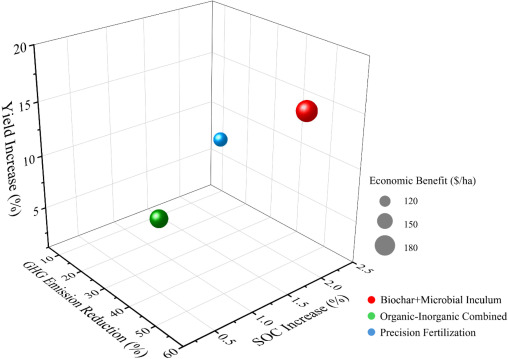
| Figure reproduced from the original article Figure | The diagram compares agricultural practices in terms of GHG emission reduction, SOC increase, and crop yield improvement, highlighting their overall benefits for low-carbon agriculture.
Content adapted from Liu et al.


