Search
Potential of enhanced-efficiency nitrogen fertilizers in reducing nitrogen and carbon losses in a sandy soil integrated crop-livestock system
Sources of information

Introduction: Conventional urea is widely used because of its high nitrogen content and low cost, but substantial nitrogen can be lost through ammonia (NH₃-N) volatilization, reducing fertilizer effi ciency and increasing environmental impacts. This three-year field study evaluated whether en hanced-efficiency fertilizers—NBPT + Duromide-treated urea and slow-release urea-formalde hyde—could reduce NH₃-N losses and CO₂ emissions compared with conventional urea in a sandy soil integrated crop–livestock system (ICLS) in Brazil.

Key findings: Conventional urea produced the highest NH₃-N losses, reaching up to 33% of applied N. Urea-formaldehyde showed the most consistent performance, reducing NH₃-N losses by approx imately 45–57% across the three years and CO₂ emissions by up to 8% compared with conventional urea. NBPT + Duromide initially reduced NH₃-N losses by about 52%, but its effectiveness declined substantially over time, indicating that enhanced-efficiency fertilizer performance can vary with en vironmental and management conditions, particularly the presence of crop residues in ICLS.
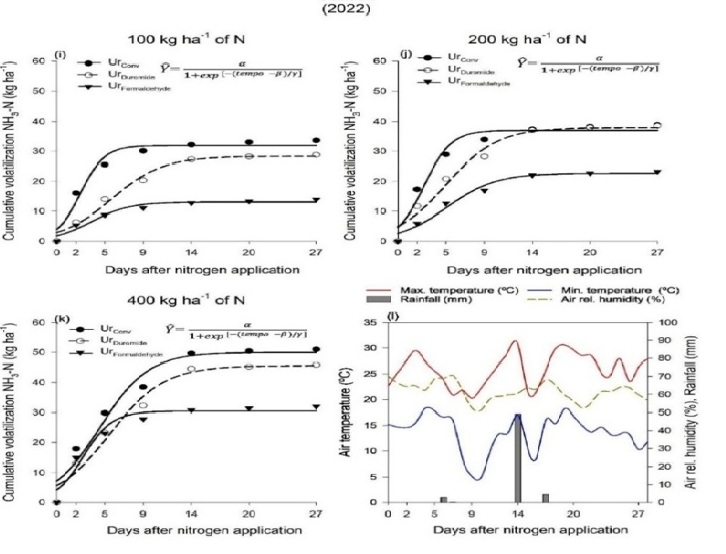
 

Figure| Cumulative NH₃-N volatilization from three N fertilizers (UrConv, UrDuromide, and UrFormaldehyde) at 100, 200, and 400 kg N ha⁻¹ during 2020–2022, with corresponding climatic conditions.

Content adapted from Oliveira et al. | Image reproduced from the original article

Viewed Articles
Potential of  enhanced-efficiency nitrogen fertilizers in reducing  nitrogen and carbon losses in a sandy soil integrated crop-livestock  system
Introduction: Conventional urea is widely used because of its high nitrogen content and low cost, but substantial nitrogen can be lost through ammonia (NH₃-N) volatilization, reducing fertilizer effi
Read More
A theoretical framework to improve the adoption of green integrated pest management tactics
March 18, 2024 | Communications Biology | Introduction: Despite the availability of environmentally friendly pest control options, uptake of green Integrated Pest Management (IPM) remains slow. A mult
Design considerations for net zero energy buildings for intensive, confined poultry production: A review of current insights, knowledge gaps, and future directions
February, 2022 | Renewable and Sustainable Energy Reviews | Introduction: Poultry housing may account for up to 50% of total non-renewable energy use and 20-35% of the life cycle impacts of poultry pr
Potential soil organic carbon sequestration vis-a-vis methane emission in lowland rice agroecosystem
August 26, 2023 | Environmental Monitoring and Assessment |  Introduction: Lowland rice systems present a well-known climate trade-off, as management practices that increase soil organic carbon (SOC)
Eating healthy or wasting less? Reducing resource footprints of food consumption
April 29, 2021 | Environmental Research Letters | Source |  Introduction: Researchers from the University of Freiburg and University of Kassel (Germany), together with the Vienna University of Economi
Climate-smart pest management: building resilience of farms and landscapes to changing pest threats
February 25, 2019 | Journal of Pest Science |  Introduction: Climate change is intensifying crop pest threats globally, disrupting species distribution, outbreak timing, and pest–natural enemy dynamic
TOP