Introduction: Chemical fertilizers have been essential to boosting food production worldwide, but nutrients that crops fail to take up can be lost to the atmosphere or waterways, leading to greenhouse gas emissions, water contamination, soil degradation, and higher farming costs. In this review, Asadu and colleagues looked at how enhanced-efficiency fertilizers (EEFs) are produced, how they regulate nutrient release, and how they may contribute to more sustainable farming. The review covers slow- and controlled-release fertilizers, stabilized fertilizers, and products that use coatings or chemical inhibitors.
Key findings: The review finds that enhanced-efficiency fertilizers (EEFs) can release nutrients more gradually or slow nitrogen transformations, helping nutrient supply better match crop demand. This improves fertilizer-use efficiency and reduces losses through ammonia volatilization, nitrate leaching, and greenhouse gas emissions while maintaining crop productivity. However, some coated fertilizers remain costly, and the synthetic polymers and solvents used in their production may create additional environmental impacts. Their performance can also vary depending on soil type, crop, climate, and product quality. The authors therefore emphasize the development of affordable, biodegradable coating materials, more consistent field performance, and fertilizer selection suited to local soil and crop conditions, together with organic inputs, biofertilizers, and precision nutrient management to support climate-smart and low-carbon agriculture.
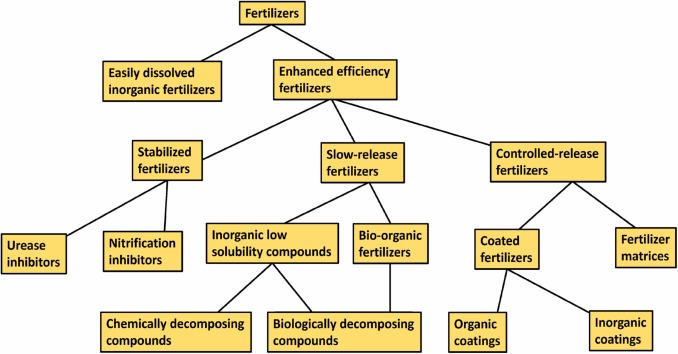
Figure| Enhanced efficiency fertilizers.
Content adapted from Asadu et al. | Figure reproduced from the original article


