Introduction: Controlled-release fertilizers (CRFs) can improve nutrient-use efficiency by gradually releasing nutrients according to crop demand. However, conventional CRFs commonly use petroleum-based polymer coatings that are non-renewable and difficult to degrade, potentially accumulating as microplastics in soil and affecting soil properties and plant growth. Although bio-based polyurethane coatings have been developed from renewable materials such as vegetable oils, lignin, starch, and cellulose, most only replace the soft segment, while the hard segment still relies on poorly degradable petroleum-based aromatic isocyanates. To address this limitation, the study developed a fully bio-based polyurethane coating (CO-LTI) using renewable castor oil and lysine-derived LTI and evaluated its controlled-release performance, soil biodegradation mechanism, and effects on Chinese cabbage growth and soil bacterial communities.
Key findings: The fully bio-based CO-LTI coating successfully controlled N release through a physical-barrier effect. Increasing the coating percentage from 3% to 6% increased coating thickness from 19–22 μm to 42–51 μm and extended the time for >80% N release from approximately 5 to 11 days. In soil, CO-LTI progressively degraded and reached 27% weight loss after 12 months, with SEM (Scanning Electron Microscopy), AFM (Atomic Force Microscopy), and XPS (X-ray Photoelectron Spectroscopy) analyses indicating surface erosion, pore formation, oxidative degradation, and microbial involvement. Low coating concentrations promoted Chinese cabbage seed germination, whereas higher concentrations after degradation slightly inhibited plant growth. Coating degradation also altered the abundance, diversity, and composition of soil bacterial communities. Overall, CO-LTI shows potential as a renewable and biodegradable coating for environmentally friendly CRFs, although its long-term impacts on plants and soil ecosystems require further evaluation.
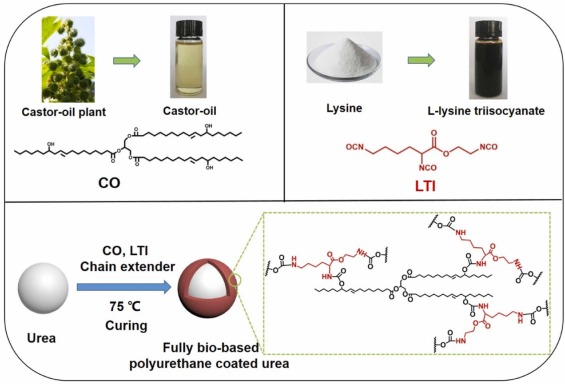
Figure |Synthesis process of CO-LTI and preparation route of coated urea.
Content adapted from Dong et al. | Figure reproduced from the original article


