Search
Biochar-based slow-release fertilizers: From nutrient carrier to intelligent regulator in soil-plant systems-a review and perspective
Sources of information

Introduction: Conventional fertilizers release nutrients rapidly and often fail to synchronize nutrient availability with crop demand, resulting in substantial nutrient losses through leaching, volatilization, and runoff, as well as associated water pollution and greenhouse gas emissions. Traditional controlled-release fertilizers can reduce these losses but generally rely on passive diffusion and fixed release patterns. Biochar-based slow-release fertilizers (BSRFs) offer a more advanced approach because biochar’s porous structure, high surface area, and surface functional groups enable nutrient retention and controlled release while also improving soil properties. This review examines the transition of BSRFs from passive nutrient carriers toward intelligent regulators capable of responding to rhizosphere conditions and coordinating nutrient supply, carbon sequestration, nutrient cycling, and microbial processes.

Key findings: BSRFs can improve nutrient-use efficiency by regulating nutrient release through physical barriers, chemical interactions, and ion exchange, while emerging pH-, moisture-, and temperature-responsive designs offer the potential to better synchronize nutrient supply with crop demand. Beyond nutrient delivery, BSRFs can support nutrient recycling, improve soil health and rhizosphere microbial activity, enhance carbon sequestration, and potentially reduce greenhouse gas emissions. However, long-term field validation, economic and life-cycle assessments, and ecological safety evaluations are still needed before widespread application.
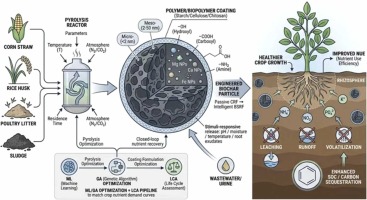
Content adapted from Liang et al. | Figure reproduced from the original article

Viewed Articles
Biochar-based slow-release fertilizers: From nutrient carrier to intelligent regulator in soil-plant systems-a review and perspective
Introduction: Conventional fertilizers release nutrients rapidly and often fail to synchronize nutrient availability with crop demand, resulting in substantial nutrient losses through leaching, volati
Read More
A hybrid sustainability performance measurement approach for fresh food cold supply chains
April 20, 2023 | Journal of Cleaner Production | Source |  Introduction: Fresh food cold supply chains (CSCs) in developing countries face major sustainability issues, including food waste, high energ
Tailoring Australian carbon farming can realise greater co-benefits
January 20, 2026 | Nature Communications |  Introduction: This study, led by the Tasmanian Institute of Agriculture at the University of Tasmania (Australia) with participation from industry and resea
Rice paddy soils are a quantitatively important carbon store according to a global synthesis
August 06, 2021 | Communications Earth & Environment |  Introduction: Rice paddies are widely discussed for methane emissions, but their role as carbon stores is less consistently quantified. Led by C
Design considerations for net zero energy buildings for intensive, confined poultry production: A review of current insights, knowledge gaps, and future directions
February, 2022 | Renewable and Sustainable Energy Reviews | Introduction: Poultry housing may account for up to 50% of total non-renewable energy use and 20-35% of the life cycle impacts of poultry pr
Crop pest responses to global changes in climate and land management
April 8, 2025 | Nature Reviews Earth & Environment  Introduction: This review led by researchers at Hebei University and the Chinese Academy of Agricultural Sciences (CAAS) explains how global change
TOP