Introduction: Intensive rice production relies heavily on chemical fertilizers, particularly nitrogen (N), but substantial N losses through ammonia (NH₃) volatilization can reduce nitrogen-use efficiency and cause environmental pollution. Controlled-release blended fertilizers (CBF) can provide a gradual and balanced supply of nutrients that better matches crop demand, potentially improving nutrient availability while reducing losses. However, the effects of CBF containing different sources and ratios of phosphorus (P) and potassium (K) on N transformation and NH₃ volatilization in rice fields remain insufficiently understood. This two-year field study therefore investigated whether CBF could regulate soil enzyme activities and N transformation, reduce NH₃ volatilization, improve plant N uptake and N-use efficiency, and ultimately enhance rice growth and yield.
Key findings: Controlled-release blended fertilizers (CBF) improved N utilization and reduced NH₃ losses in rice fields. CBF2, with a 50% reduction in potassium chloride, performed best, reducing cumulative NH₃ volatilization by 64% in 2019 and 38% in 2020, while increasing plant N uptake by 44% and 34%, respectively. CBF also enhanced N-metabolism enzymes and genes involved in N transport and assimilation, improving N availability and utilization. As a result, grain yield increased by 9.7–17.5% in 2019 and 3.1–8.2% in 2020, demonstrating the potential of CBF to reduce N losses while improving rice productivity.
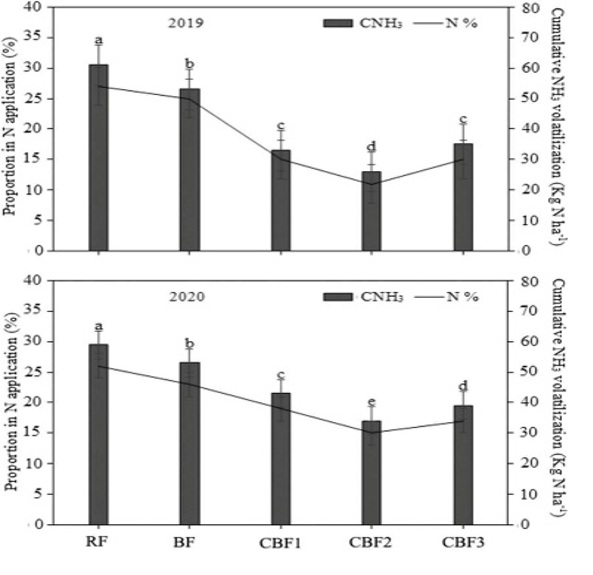
Figure | Controlled-release blended fertilizers (CBF) reduced cumulative NH₃ volatilization compared with regular fertilization (RF), with CBF2 showing the greatest reduction—64% in 2019 and 38% in 2020. Different letters indicate significant differences among treatments (p < 0.05).
Content adapted from Ahmad et al. | Figure reproduced from the original article


