Introduction: Modern agriculture relies heavily on synthetic nitrogen fertilizers, which contribute to soil degradation, water eutrophication, and greenhouse gas emissions, making biological nitrogen fixation (BNF) a promising sustainable alternative. However, foliar application of N-fixing bacteria is limited by harsh leaf-surface conditions such as UV radiation, high oxygen, rainfall, and desiccation. To address this challenge, the researchers developed a TA-Fe-SA nanocoating for Klebsiella variicola W12 to enhance bacterial protection, adhesion, biofilm formation, and stable leaf colonization, with the goal of improving BNF and plant nitrogen supply while reducing dependence on synthetic N fertilizer.
Key findings: The results showed that the nanocoating effectively protected the N-fixing bacterium W12 from harsh conditions on leaf surfaces, including UV radiation, desiccation, oxidative stress, and rainfall, while improving bacterial adhesion and survival. At 14 days after application, nanocoated W12 showed approximately 3.3-fold higher colonization on rice leaves than uncoated bacteria and increased the contribution of biological nitrogen fixation to plant nitrogen from 13.69% to 27.89%. In field trials, the nano-inoculant increased rice grain yield by 27.14% and total nitrogen content by 28.09%, with the potential to reduce chemical nitrogen fertilizer use by approximately 74.38 kg N/ha. Overall, this approach improves the survival and colonization of N-fixing bacteria on leaves, enhancing natural nitrogen supply to crops and potentially reducing dependence on chemical fertilizers.
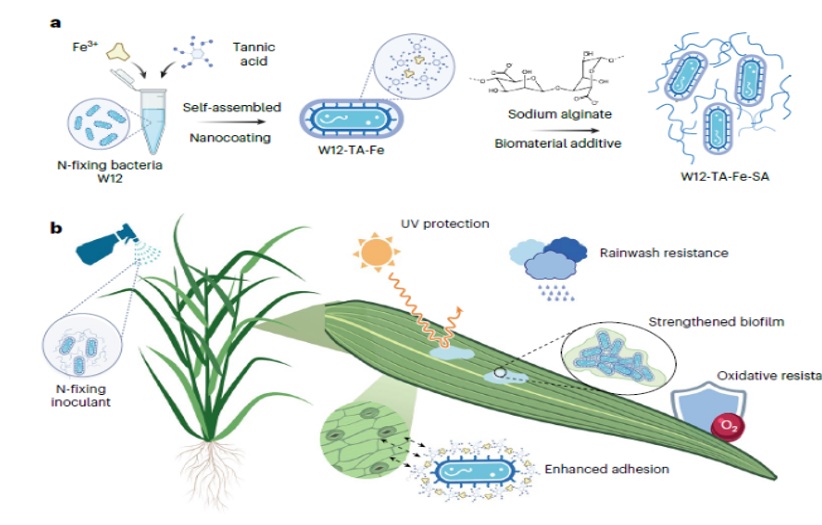
Figure | Schematic illustration of preparation and foliar application of nanocoated N-fixing bacteria.
Content adapted from Liao et al. | Figure reproduced from the original article


