June 2023 | Journal of Environmental Management | Volume335
Introduction: Agricultural land does not have to choose between producing food, generating renewable energy, and protecting biodiversity. Schneider and her interdisciplinary research team explored a more integrated pathway by combining biodiversity agriphotovoltaics with electrified agricultural machinery. Using a survey of 116 farmers, a GIS-based assessment in Lower Saxony, Germany, and field-scale energy simulations, the study examined whether solar electricity generated alongside biodiversity-oriented flower strips could directly support electric farm machinery. The results point toward a future in which farms could simultaneously produce food and renewable electricity, strengthen ecological connectivity, and reduce their dependence on fossil fuels.
Key findings: The study found that only a relatively small share of farmland may be needed to support agricultural electrification. In the field-scale scenario, allocating about 3% of agricultural land to agriphotovoltaics could provide much of the energy required for most crop-production operations. At the regional scale, combining solar installations with flower strips showed a theoretical technical potential of approximately 78 GWp (gigawatts-peak) in Lower Saxony while improving connectivity between fragmented habitats. Mobile battery storage could further improve the match between solar generation and machinery demand, although energy-intensive harvesting remains difficult to fully electrify. Importantly, farmers who associate agriphotovoltaics with greater energy self-sufficiency also showed stronger intentions to adopt the technology, suggesting that directly linking renewable energy production to farm operations could help accelerate its uptake.
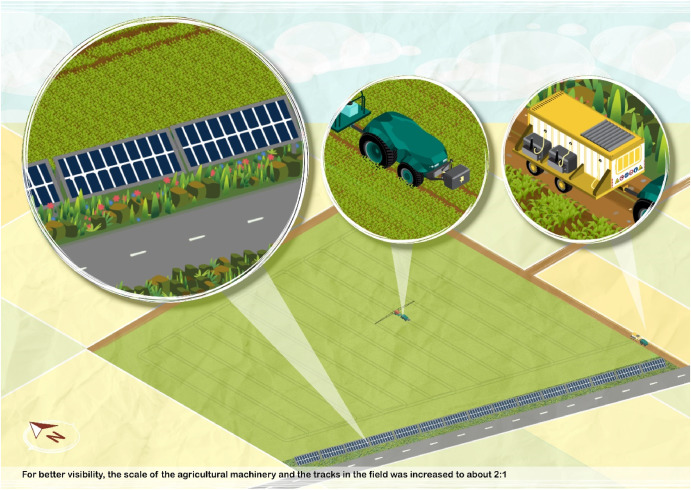
Figure | The local scenario of the energy-food-biodiversity nexus: A 9 m strip of biodiversity agriphotovoltaics is located at the field path. The tractor in this illustration is battery powered. Mobile battery replacement systems can be found at the edge of the field.
Content adapted from Schneider et al. | Image reproduced from Schneider et al.


