April 2025 | Energy Conversion and Management | Volume 330
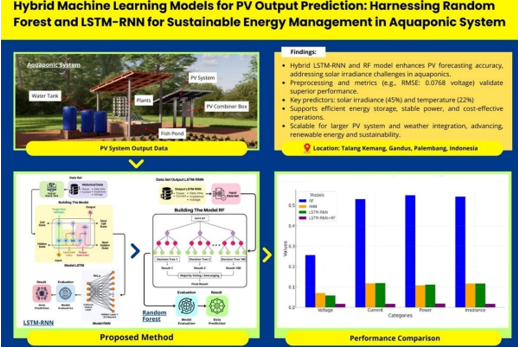
Introduction: Dewi and her research team demonstrated how hybrid machine learning could improve solar energy forecasting and support more reliable energy management in aquaponic production systems. Solar-powered aquaponics requires continuous electricity for water circulation, aeration, lighting, and other essential equipment, yet fluctuating solar irradiance can make renewable power supply difficult to manage. To address this challenge, the team combined a Long Short-Term Memory Recurrent Neural Network (LSTM-RNN) with Random Forest (RF), using LSTM-RNN to capture temporal patterns in photovoltaic (PV) data and RF to refine predictions and identify influential variables. The hybrid approach links accurate PV forecasting with smarter energy storage and distribution, helping aquaponic systems maintain stable operation while improving renewable energy utilization.
Key findings: The hybrid LSTM-RNN-RF model outperformed standalone models, achieving an overall RMSE of 3.12% and MAE (mean absolute error) of 2.67%, with parameter-specific RMSE (root mean square error) values of 0.0768 for voltage, 0.037 for current, 0.041 for power, and 0.0363 for irradiance. Random Forest identified solar irradiance as the most influential predictor, followed by temperature, while the hybrid framework also supported detection of abnormal PV performance such as shading and degradation. More accurate forecasting enables aquaponic systems to better coordinate battery storage and electricity use—storing energy during periods of strong sunlight and maintaining power for critical equipment when solar availability declines. The findings show how AI-based forecasting can improve renewable-energy utilization, operational reliability, and energy management in controlled agricultural production systems.
Content adapted from Dewi et al. | Image reproduced from Dewi et al


