From Technological Innovation to Real-World Practice: What Does Circular Agriculture Need Beyond Technology?
1. The Sticking Point: Feasible, but Not Adopted
Circular agriculture technologies keep advancing, yet many results stall between the research plot and the farm. Is a technically feasible practice worth investing in, and who should pay for it? This article answers with the framework of Khanna et al. (2024), international cases and first-hand experience from the FFTC Smart Net-Zero (SNZ) Project.
2. Four Barriers: Technology Available ≠ Technology Adopted
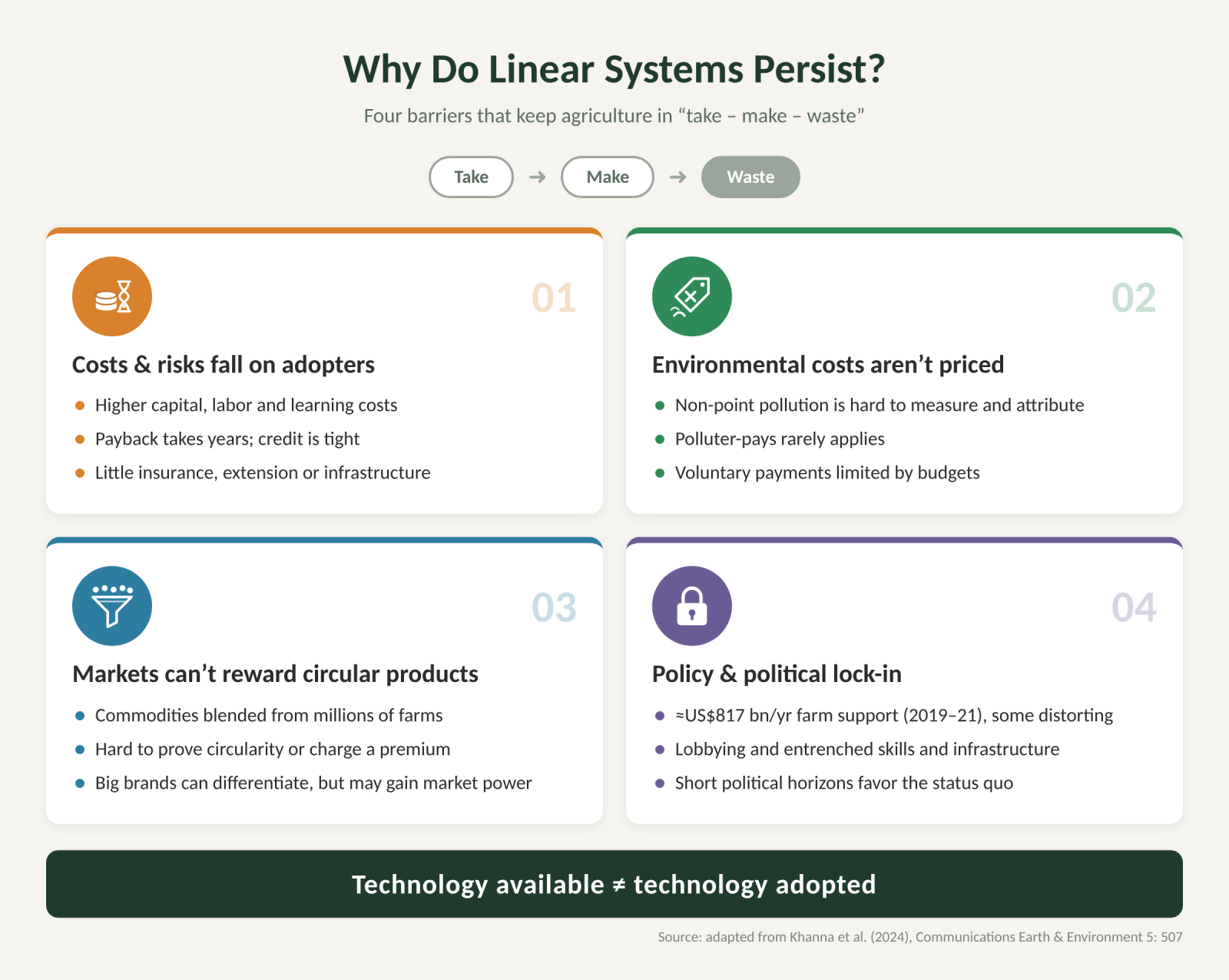
Even technique highly developed such as Europe is no exception: only 12% of conventional Dutch dairy farms use sensors, because farmers see no clear return and methane cuts go unrewarded (Hogeveen et al., 2026).
3. The Balance Point: More Circular Is Not Always Better
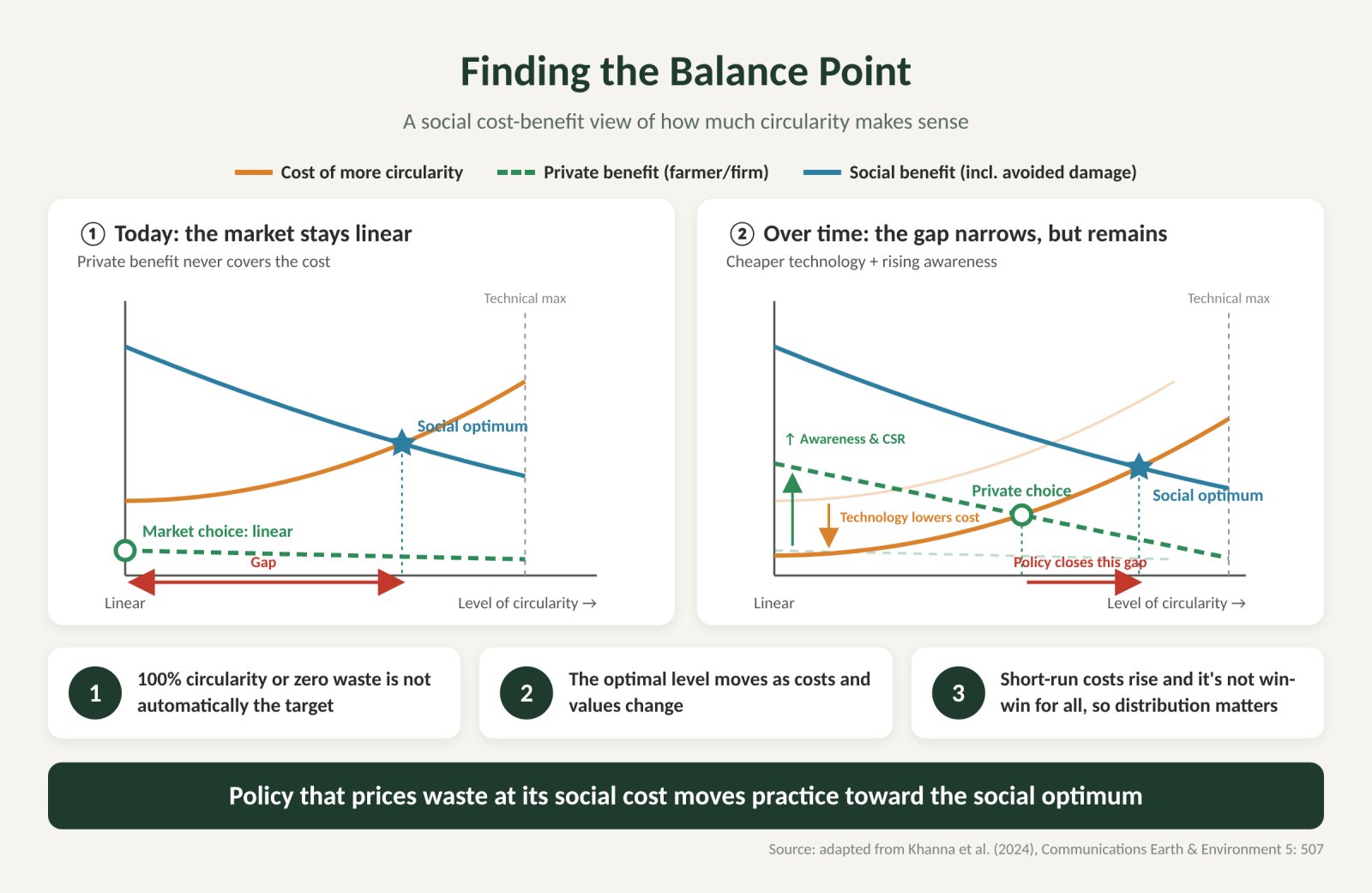
Khanna et al. weigh the cost of each further step toward circularity against its social benefit. A trial in Gansu, China, shows the gap: green manure with biochar cut global warming potential by 36.9%, but farmers bore the extra cost while the carbon value was never paid to them (Liu et al., 2026).
Closing the gap takes five pathways:
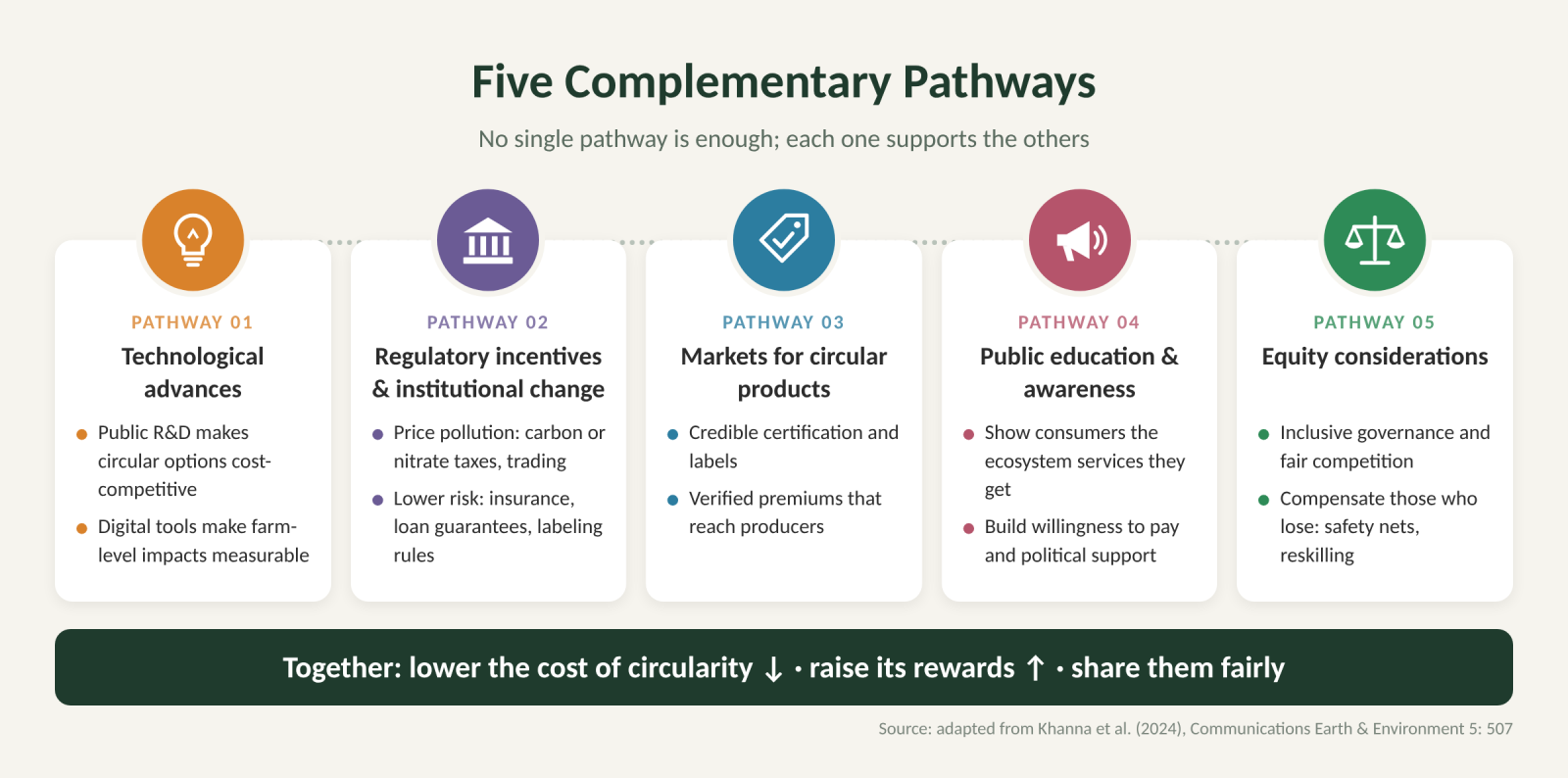
Equity matters most in developing regions, where nutrient recovery potential is highest, but capacity is weakest (Liao et al., 2026).
4. How Cases Overcame the Barriers
Successful international and FFTC SNZ cases (in gold):
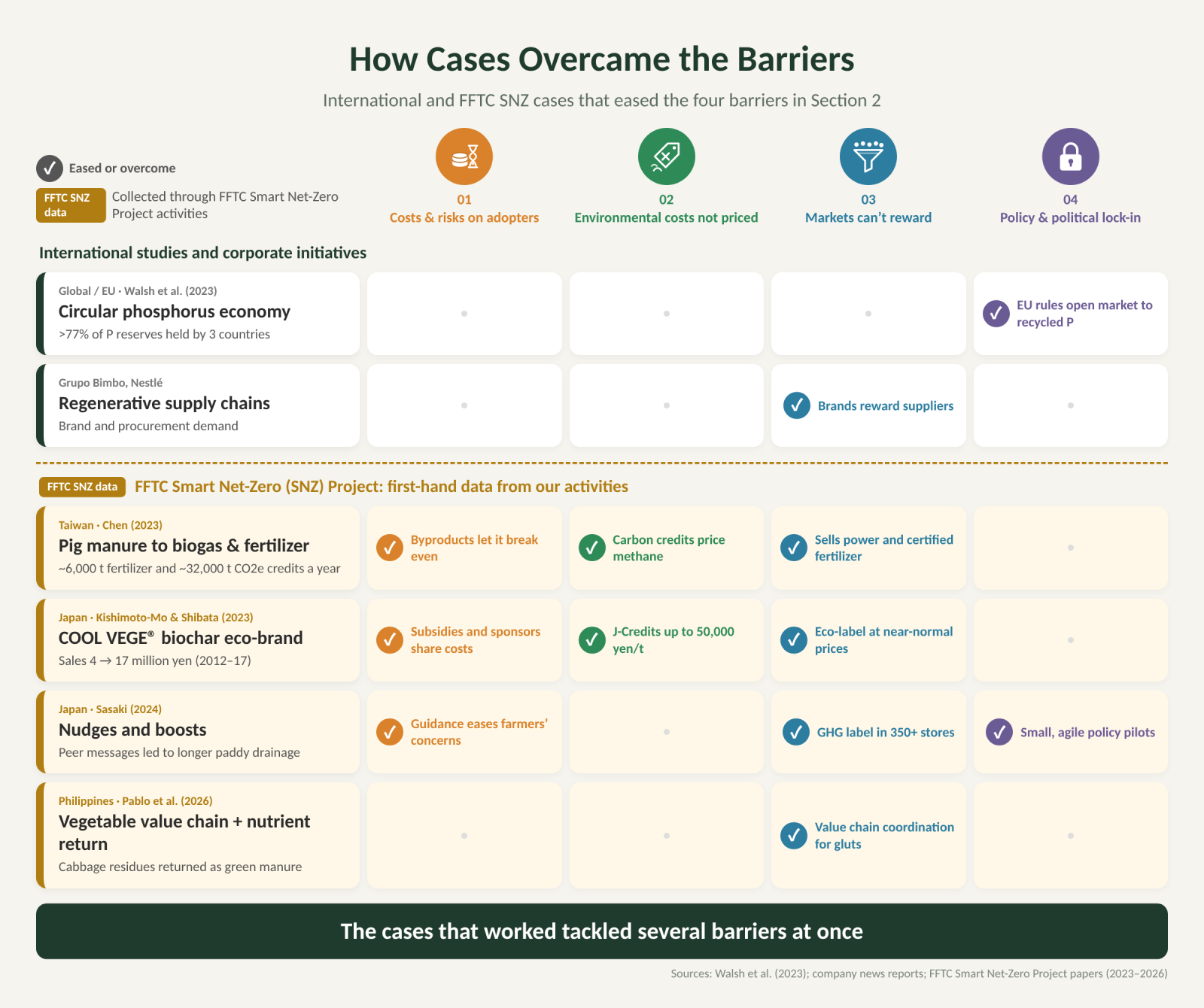
- Costs and risks: a Taiwanese pig farm breaks even through power and fertilizer sales (Chen, 2023); Japan’s COOL VEGE® shares costs through subsidies and corporate sponsors (Kishimoto-Mo and Shibata, 2023).
- Unpriced environmental costs: carbon credits give methane capture and biochar a price.
- Market rewards: eco-labels, carbon labels and corporate procurement make sustainable practices visible to buyers.
- Policy lock-in: the EU opened its market to recycled phosphorus (Walsh et al., 2023), and Japan tests policy through small pilots (Sasaki, 2024).
In framework terms, the successful cases raised private benefits and lowered costs at the same time. None succeeded on technology alone, and equity remains the weakest link.
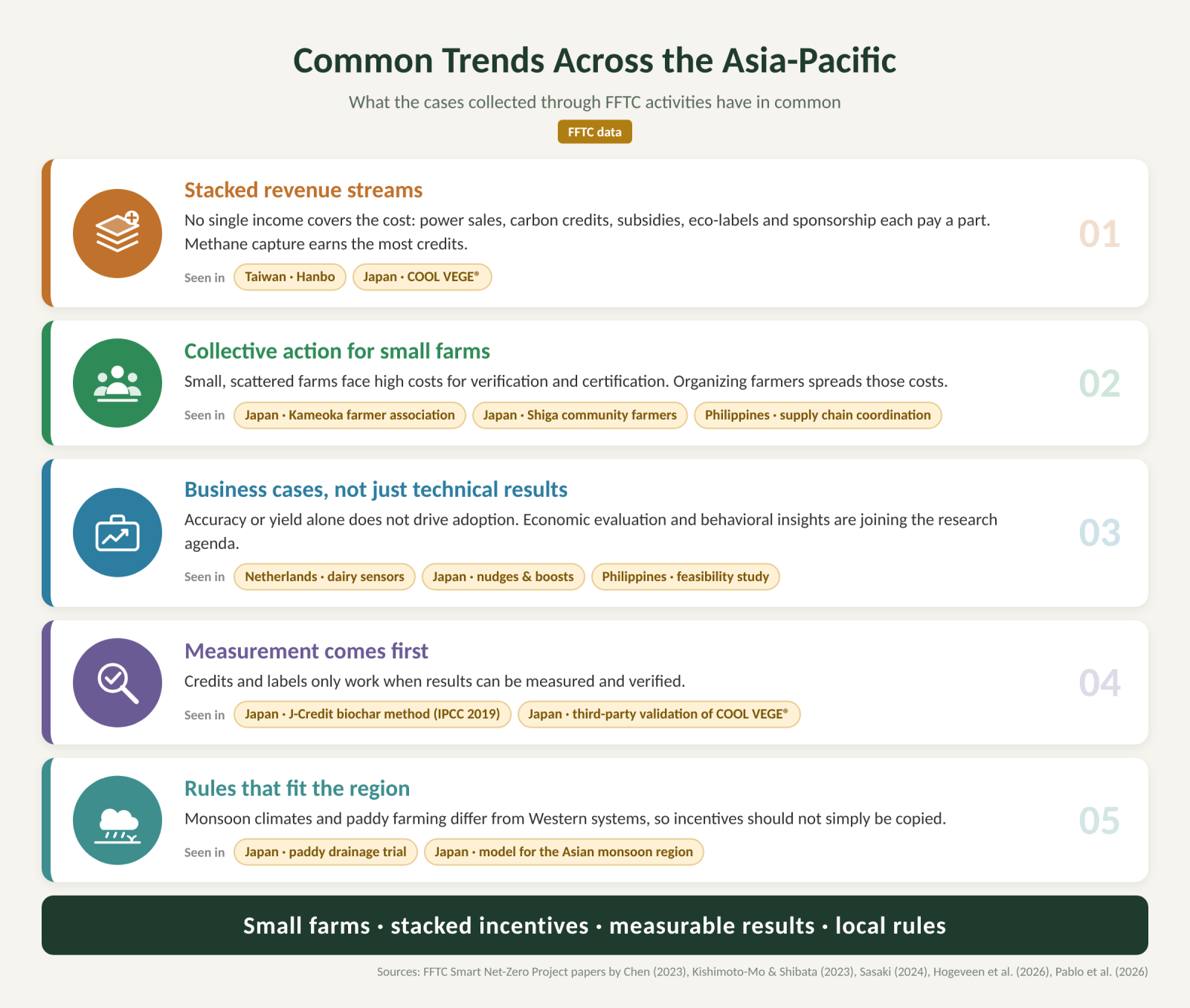
Furthermore, the success of FFTC SNZ also reveals common trends in the Asia-Pacific region, including: diversified income streams, collective action by smallholder farmers, emphasis on business models, the availability of measurement and verification capabilities, and the establishment of rules that are appropriate for the region.
5. Conclusion
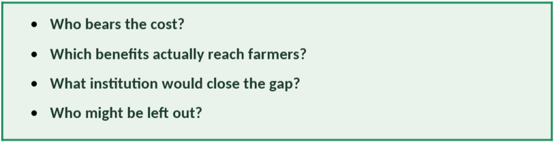
The four barriers explain why technology alone does not spread, the framework shows how far circularity should go, and the five pathways are the tools that close the gap. Before promoting a circular practice, ask:
There is no one-size-fits-all answer. Combining cross-border experience with economic and environmental assessment is how we find pathways that are viable, sustainable and fair.
References
Khanna, M., D. Zilberman, G. Hochman, and B. Basso. 2024. An economic perspective of the circular bioeconomy in the food and agricultural sector. Communications Earth & Environment 5: 507. https://doi.org/10.1038/s43247-024-01663-6
Liao, C., S. Zhou, S. Shin, D. Lu, Y. Lee, S. Xu, Y. Tu, K. Mosdossy, L. Li, R. Nelson, and J. Lehmann. 2026. Towards global nutrient justice via a circular bionutrient economy. Nature Reviews Earth & Environment 7: 743–755. https://doi.org/10.1038/s43017-026-00831-w
Liu, R., D. Chang, J. Zhang, R. Li, J. Wu, H. Liang, Y. Cheng, and W. Cao. 2026. Co-utilization of green manure and biochar with 30% nitrogen reduction improves soil quality and mitigates carbon footprint. Farming System 4: 100190. https://doi.org/10.1016/j.farsys.2025.100190
Velasco-Muñoz, J. F., J. A. Aznar-Sánchez, B. López-Felices, and I. M. Román-Sánchez. 2022. Circular economy in agriculture. An analysis of the state of research based on the life cycle. Sustainable Production and Consumption 34: 257–270. https://doi.org/10.1016/j.spc.2022.09.017
Walsh, M., G. Schenk, and S. Schmidt. 2023. Realising the circular phosphorus economy delivers for sustainable development goals. npj Sustainable Agriculture 1: 2. https://doi.org/10.1038/s44264-023-00002-0
FFTC Smart Net-Zero Platform papers
Chen, Y. M. 2023. The Decarbonized Business Model of Circular Agriculture. TARI-TLRI-TNDARES-NARO-FFTC Workshop: Developing Low Carbon Farming for Smallholders in Asian and Pacific Region: Options, Mitigation Potential, and Challenges. FFTC Smart Net-Zero Project (1st Phase).
https://doi.org/10.56669/ZVYV2626
Hogeveen, H., M. I. Sani, and M. van der Voort. 2026. The Economic Challenge in Using Smart Technology: Towards Low Carbon Food Production. International Workshop on Smart Low-Carbon Agrifood Systems: Digital Innovation in Crops, Livestock, and Pathways to Net-Zero. FFTC Smart Net-Zero Project (1st Phase). https://doi.org/10.56669/UAYT3156
Kishimoto-Mo, A. W. and A. Shibata. 2023. “COOL VEGE®”: Pioneering Eco-brand for Biochar Soil Carbon Sequestration in the Real World. TARI-TLRI-TNDARES-NARO-FFTC Workshop: Developing Low Carbon Farming for Smallholders in Asian and Pacific Region: Options, Mitigation Potential, and Challenges. FFTC Smart Net-Zero Project (1st Phase). https://doi.org/10.56669/UGGX7681
Pablo, J. P., C. C. Launio, J. R. M. Kilakil, and J. A. Somyden. 2026. AGRI-INNOVATE: Optimizing Efficiency of the Vegetable Value Chain for Nutrient Return and Circular Economy. International Workshop on Smart Low-Carbon Agrifood Systems: Digital Innovation in Crops, Livestock, and Pathways to Net-Zero. FFTC Smart Net-Zero Project (1st Phase). https://doi.org/10.56669/HLTK5851
Sasaki, H. 2024. Behavioral Changes in Farmers and Consumers Towards a Greener Agri-food System. SNZ International Conference: Strategies and Actions to Incentivize GHG Emission Reductions and Carbon Offset within Sustainable Agrifood Systems. FFTC Smart Net-Zero Project (1st Phase). https://doi.org/10.56669/VPAZ2021
Further reading
Grupo Bimbo Expands Regenerative Agriculture to Over 500,000 Hectares. Mexico Business News. 29 September 2026. https://mexicobusiness.news/agribusiness/news/bimbo-surpasses-500000ha-under-regenerative-agriculture
Japan Turns Underused Bamboo into Low-Carbon Materials and Agricultural Resources. World Economic Forum (WEF). 15 September 2026. https://www.weforum.org/stories/climate-action-and-waste-reduction/japan-bamboo-underused-natural-resource-low-carbon-solution
Nestlé Vietnam CEO Recognized for Sustainable Agriculture and Circular Economy Leadership. Vietnam News. 12 October 2026. https://vietnamnews.vn/economy/1801792/nestle-vietnam-ceo-honoured-with-2026-thanh-giong-cup.html


