Search
Loss of Natural Capital due to Expansion of Cropland in China

September 25, 2023 | Nature Ecology & Evolution

 Introduction: Globally, the increasing demand for food has led to widespread loss of biodiversity and ecosystem services. The research team from the Chinese Academy of Sciences utilized data spanning 2000 to 2015 from national ecosystem assessments in China, mapping the loss of four crucial ecosystem services (water retention, soil retention, sandstorm prevention, and carbon sequestration), along with potential wildlife habitat due to cropland expansion. 

Key findings: The study reveals that, China as the global main grain producer, at the national level from 2000 to 2015, land reclamation for cropland has undermined gains in wildlife habitat and the ecosystem services of water retention, sandstorm prevention, carbon sequestration, and soil retention by 113.8%, 63.4%, 52.5%, 29.0%, and 10.2%, respectively.

Conclusion:  This underscores the need to invest in restoration of natural capital to achieve global sustainability goals. Balancing the demands of agriculture with the preservation of ecosystems is essential to ensure a more sustainable future.

 Read more: Natural capital investments in China undermined by reclamation for cropland
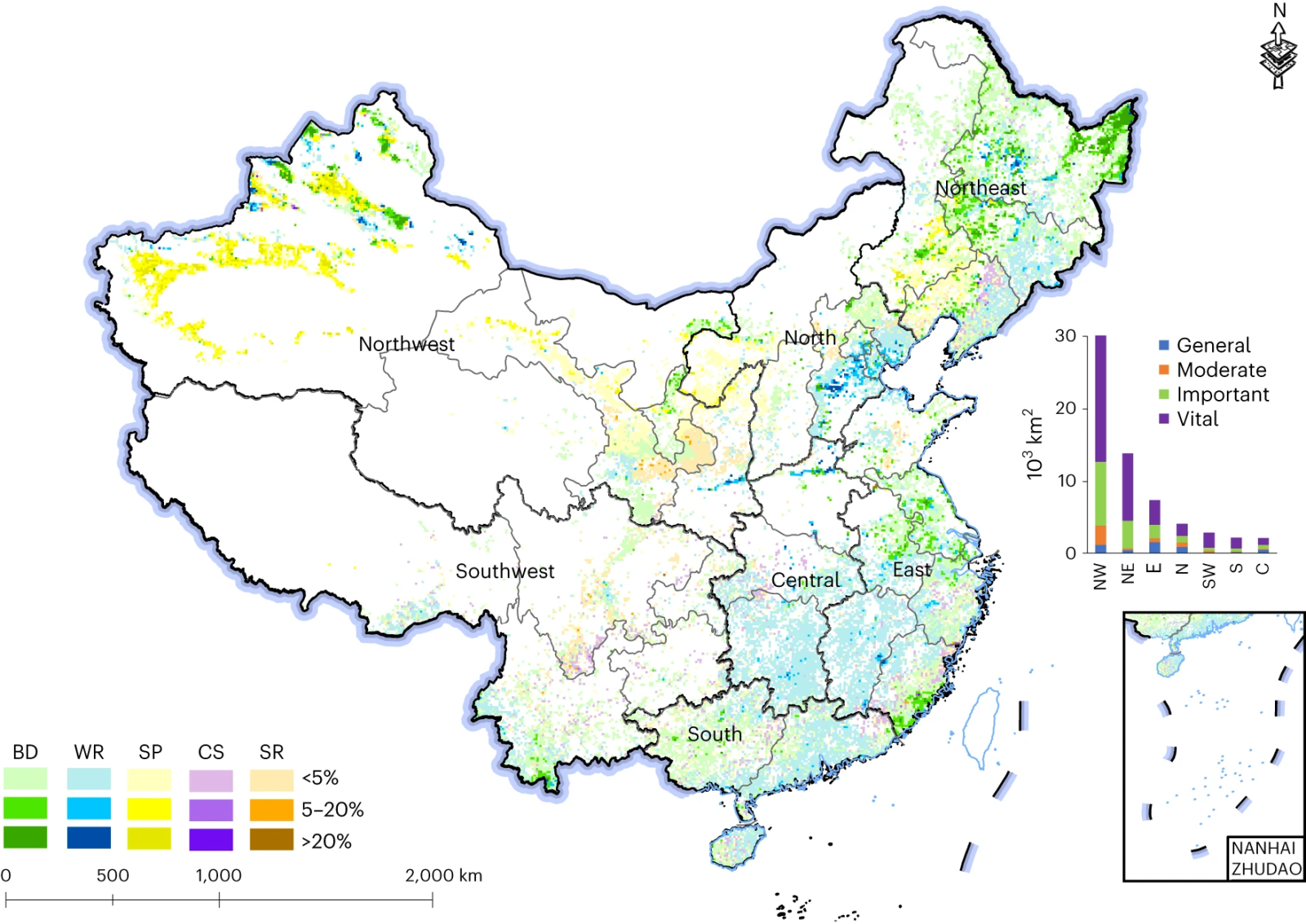
 

Fig. | Vital ecosystems converted to cropland across China, 2000–2015.  

Viewed Articles
Loss of Natural Capital due to Expansion of Cropland in China
September 25, 2023 | Nature Ecology & Evolution |  Introduction: Globally, the increasing demand for food has led to widespread loss of biodiversity and ecosystem services. The research team from the
Read More
Diversifying crop rotation increases food production, reduces net greenhouse gas emissions and improves soil health
January 3, 2024 | Nature Communications | Source | Introduction: Conventional intensive farming boosts yields but also drives GHG emissions, soil degradation, and climate vulnerability, especially in
Mulberry based agroforestry system and canopy management practices to combat soil erosion and enhancing carbon sequestration in degraded lands of Himalayan foothills
December, 2024 | Environmental and Sustainability Indicators | Source |  Introduction: Agroforestry offers a cost-effective solution for restoring degraded mountain lands by stabilizing soil, reducing
Rice paddy soils are a quantitatively important carbon store according to a global synthesis
August 06, 2021 | Communications Earth & Environment |  Introduction: Rice paddies are widely discussed for methane emissions, but their role as carbon stores is less consistently quantified. Led by C
Opportunities for mitigating net system greenhouse gas emissions in Southeast Asian rice production: A systematic review
February 28, 2024 | Agriculture, Ecosystems & Environment | Source |  Introduction: Despite existing mitigation efforts, integrated approaches addressing system-wide emissions—including soil organic c
An overview of underutilized benefits derived from Azolla as a promising biofertilizer in lowland rice production
January, 2023 | Heliyon | Source |  Introduction: Azolla, an aquatic fern with nitrogen-fixing capabilities through its symbiotic association with Aenabana azollae, has the potential to serve as an ec
TOP