Search
Looking up and going down: Does sustainable adaptation to climate change ensure dietary diversity and food security among rural communities or vice versa?
Sources of information

March 20, 2023 Frontiers in Sustainable Food Systems |

Researchers from Pakistan, Saudi Arabia, and the United States conducted a study that highlights the importance of sustainable food systems in ensuring food security and addressing climate change. The study explores the factors influencing sustainable adaptation to climate change and establishes a connection between sustainable adaptation and the food security of rural households. Data was collected from 384 farmers in Pakistan using face-to-face surveys and analyzed using statistical techniques. The results showed that factors such as education, farm size, credit access, extension services, internet use for agriculture information, women's participation in farm-related decision making, and recognizing climate change as a significant problem for agriculture positively influenced sustainable adaptation to climate change. Furthermore, farmers with higher levels of sustainable adaptation consumed more diverse diets and had better food security compared to those with lower levels of adaptation. The research suggests that farmers can improve food and nutrition outcomes by adopting sustainable practices to address climate change. The findings have significant policy implications for achieving sustainable development goals related to zero hunger and climate action in developing countries.
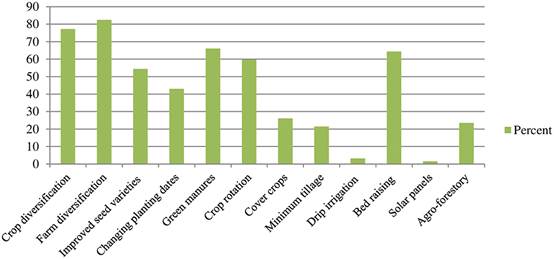
                    

Climate change adoption status in the region

 
Viewed Articles
Looking up and going down: Does sustainable adaptation to climate change ensure dietary diversity and food security among rural communities or vice versa?
March 20, 2023 | Frontiers in Sustainable Food Systems | Researchers from Pakistan, Saudi Arabia, and the United States conducted a study that highlights the importance of sustainable food systems in
Read More
Ecological intensification to mitigate impacts of conventional intensive land use on pollinators and pollination
March 27, 2017 | Ecology Letters |Introduction: Human land use has already altered roughly 53% of Earth's terrestrial surface, and agricultural land is projected to expand a further 10% by 2030, i
Harness agrifood value chains to help farmers be climate smart: Incentives and structures exist to improve farming practices
November 28, 2024 | Science | Source |  Introduction: At the 2023 COP28, the Emirates Declaration recognized the critical role of agrifood systems in addressing climate change. With over 160 countries
Climate-smart agroforestry systems and practices: A systematic review of what works, what doesn’t work, and why
May, 2023 | Forest Policy and Economics | Source | Introduction: Climate-smart agroforestry (CSAF) practices offer integrated solutions to climate change, food security, and environmental degradation,
Long-term evidence for ecological intensification as a pathway to sustainable agriculture
June 27 2022 | Nature Sustainability |Introduction: Whether ecological intensification (EI) can maintain crop yields while reducing reliance on nitrogen fertilizer (NF) and tillage intensity (TI) has
Blue carbon as a natural climate solution
November 1, 2021 | Nature Reviews Earth & Environment | Source | Introduction: An international research team from Australia, USA, Singapore, UK and Saudi Arabia, led by Deakin University (Australia)
TOP