Scientific Data| Source | Data |
Scientific Data is a peer-reviewed open-access journal for descriptions of datasets and research that advances the sharing and reuse of research data. Our primary content-type, the Data Descriptor, combines traditional narrative content with structured descriptions of data to provide a framework for data-sharing to accelerate the pace of scientific discovery. These principles are designed to align with and support the FAIR Principles for scientific data management and stewardship, which declare that research data should be Findable, Accessible, Interoperable and Reusable.
This dataset addresses a gap in global databases, providing a valuable resource for evaluating sustainable development goal coordination, considering economic, social, and ecological elements in the production-living-ecology space. The dataset was generated by researchers from University of Chinese Academy of Sciences from integrating global land cover data from GlobeLand30 and population density data from NASA for 2000, 2010, and 2020 to create a comprehensive global production-living-ecological space map. Verification using random sampling in ArcGIS and Google Earth images yielded high accuracy of 83.94 to 87%.
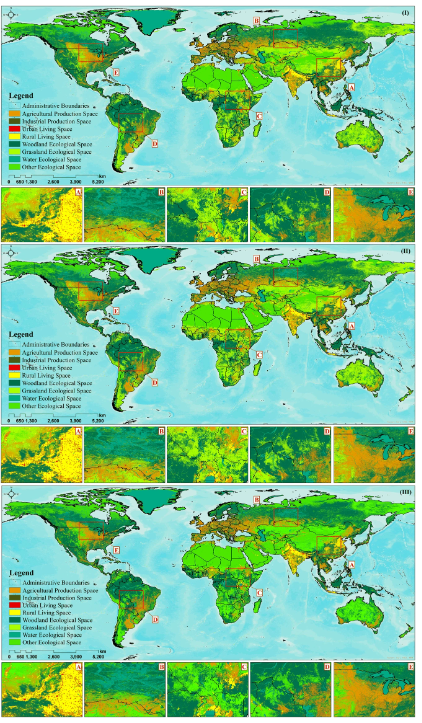
Fig. | Global production–life–ecological space classification in 2000 (I), 2010 (II), and 2020 (III).


